Strategies & Best Practices for a Smooth SAP S/4HANA Migration
Explore SAP S/4HANA migration strategies, challenges, and best practices. Learn how Merito delivers seamless SAP migration services with optimized data and module selection.
In most organizations, the decision to move to SAP S/4HANA or to re-platform Oracle or Workday, or even to rebuild key custom applications is not about ‘technology-first’. The conversation doesn’t start with ‘hey, let’s move to this tech!'. It’s about operating your day-to-day business with minimal (no) disruptions while big changes are happening underneath, and outside your ecosystem.
As executives, we sit in steering committees and hear words like ‘live readiness' and ‘hyper-care’, yet what we really care about is something more basic: Will orders still ship on time? Will payrolls run? Will we have to answer frantic calls when numbers on the new system don’t match the old one?
That’s the real backdrop for every discussion on testing and quality.
Is your SAP S/4HANA Upgrade riddled with Operational Risks?
In large enterprises, software delivery rarely runs in a straight line. Environments are unstable. Data may be missing or wrong. Teams and vendors are distributed across time zones. Often, business stakeholders are pulled into testing only when it’s already too late.
And when you layer a major SAP S/4HANA migration or a Workday rollout on top of this shaky reality, the risk profile changes really fast. What was projected on a beautiful template slide to be a ‘technical upgrade’ now morphs into an ugly, multi-year operational risk if quality isn’t handled with discipline.
One pattern our Merito experts see time and again is weak scope definition from the start. The program charter says brownfield or greenfield or selective data transition, and everyone nods along. But the real questions stay fuzzy.
Which business units are truly in scope? Which legacy integrations will be retired and which must keep running, with or without an upgrade? How much historical data is legally required?
When these decisions are not nailed down early, the testing strategy becomes more reactive than proactive.
Murphy’s law of migration: Anything that can go wrong, will go wrong!
Teams discover late in the day that a critical interface to a bank or logistics partner was not fully understood. You see last minute test cycles in half ready environments and executives get status reports that feel optimistic but not trustworthy.
Environment instability is another daily pain point. For SAP S/4HANA or Oracle programs, you often have multiple tracks running: functional build, data migration, integration, performance. Each needs its own environment or at least predictable refresh rules. Instead, you get shared systems that are constantly being patched or reconfigured.
A key scenario breaks halfway through a test cycle when someone applies a transport. Defects are raised that later turn out to be environment noise. The result is erosion of trust in the defect metrics and in the testing team itself. From a business risk view, this is serious. If we cannot trust the signal from testing, we either delay going live or accept risks blindly. Neither is good.
Data is just as bad and sometimes worse. In theory, data migration teams own the quality of data and testing teams just validate. In practice, test teams spend huge time chasing missing master data or inconsistent reference values. For example, an SAP S/4HANA order to cash test might fail not because the process design is wrong but because customer credit limits or pricing conditions were not loaded correctly.
When this happens across hundreds of scenarios, the business starts to doubt the new system. They say the process does not work, when really the data is not ready. This confusion slows decisions and hides real design defects behind a wall of noise.
Late defects are the symptom that executives see most clearly. A month before we go live, someone discovers that a key revenue recognition rule is not implemented correctly or that a Workday integration with payroll does not handle a specific union rule. These are not cosmetic issues. They hit revenue recognition compliance or employee trust. Fixing them late means emergency development changes rushed testing and often a slip in the cutover date. The board hears that the program is delayed again and confidence drops.
What is often missed is that these late defects usually trace back to earlier gaps in test design and business alignment. The right people were not involved in defining test coverage. The test cases focused on happy paths all along, not on edge cases that matter for audit and operations.
The Merito Approach: Continuous Integration, Continuous Deployment, Continuous Testing
At Merito we see testing as a control mechanism for business risk, not just a project activity. That means starting quality work at the same time as architecture and process design. It means using tools from Merito partners like Tricentis or OpenText to define traceable test assets that link requirements to test cases to defects.
It also means using platforms from partners such as Inflectra, TestRail or Perforce, in a way that fits enterprise governance rather than just adding more tools.
When test assets are structured and traceable, executives can ask a simple question: ‘For this critical business capability, show me which tests prove it works and what the latest results are.’ That transparency changes the tone of steering meetings from opinion to evidence.
Integration testing is where many SAP S/4HANA and Oracle programs really struggle. The core system may look stable in isolation, but the enterprise runs on a mesh of connections to banks, tax engines, logistics providers, CRM tools and industry platforms. Each of these has its own release calendar and its own constraints on test windows.
When integration testing is left to the end you get a traffic jam. Teams fight for limited interface environments. Stubs and mocks are built in a rush and then not trusted. Transactions fail for reasons that are hard to debug because logs are scattered across systems and vendors. From a business perspective, this is where operational risk becomes very real. A single broken interface can stop cash collection or inventory movements. A structured integration test strategy with clear ownership and early dry runs reduces that risk a lot but it needs executive sponsorship to enforce.
Performance and scalability are another area where assumptions hurt. Many leaders assume that moving to modern platforms will automatically fix performance pain. In reality, new systems often introduce new patterns like embedded analytics or more frequent background jobs. If performance testing is limited to a few synthetic scripts you miss the real workload mix. For example, during a quarter end close, the finance team might run heavy reports while sales operations push through large order volumes and integration jobs are posting from external channels. If the performance model does not reflect that combined load, you can pass testing and still fail in production.
When that happens the business impact is immediate. Users lose confidence. Workarounds appear in spreadsheets. Audit trails get messy. A serious performance test program using the right tools and realistic data protects against this but it needs stable environments and good monitoring. Stakeholder alignment sounds like a soft issue but it has hard consequences.
In many SAP S/4HANA or Workday programs the business thinks IT owns testing while IT thinks the business owns acceptance. This gap shows up when test cycles start. Business users are too busy with their day jobs to run tests. When they do join, they focus on surface level usability not on control points that auditors care about. Later when something goes wrong in production everyone asks why it was not caught in testing. The honest answer is that the right people never really engaged.
Start Right by Shifting Left
At Merito we push for clear accountability. Business process owners sign off on test coverage for their area. They know which scenarios are in scope, which are deferred and what residual risk they are accepting. That clarity is uncomfortable at first, but it leads to better decisions. Security and compliance testing also need more attention in these programs. When you introduce new platforms and integrations you expand the attack surface and the risk of data leakage.
Partners like Checkmarx, Black Duck and Sonatype help manage application security and open-source risk but tools alone are not enough. The testing strategy must include security reviews of custom extensions role design checks in SAP or Oracle and validation of data masking in non-production environments where Delphix and Synthesized plug in. If test data is not masked correctly you can end up with real customer or employee data in lower environments which is a serious compliance issue. Executives are personally accountable for some of these failures, so they need visibility into how security testing is planned and executed.
For custom development that wraps around SAP S/4HANA or Workday the challenge is often velocity. Agile teams want to release frequently. Enterprise change control wants stability. Without a strong automated testing foundation this tension leads to either slow releases or risky ones.
Merito works with partners like Tricentis, TestRail and Perforce to build pipelines where automated tests run as part of every change and results are visible to both IT and business leads. The goal is not to automate everything but to automate the high value regression checks that protect core business flows. When that is in place you can move faster without losing control. All of this comes back to one simple idea: Testing is not a phase at the end. It is a continuous activity that shapes how risk is managed throughout SAP S/4HANA migrations Oracle or Workday programs and custom development.
When environments are stable, data is realistic and stakeholders are aligned, testing becomes a reliable signal. Executives can make go live decisions based on evidence not on hope. When those conditions are missing testing becomes noise and the organization either delays endlessly or takes on hidden risk.
Merito works with enterprises to bring structure to this chaos using the combined strengths of our own expertise and our partner ecosystem including, in no particular order, Inflectra, Tricentis, OpenText, Perforce, TestRail, Checkmarx, Black Duck, Sonatype, Synthesized, and Delphix. The aim is straightforward. Reduce the chance of late surprises. Protect daily operations while big changes roll through the landscape. And give business leaders a clear view of risk so they can move forward with confidence even if the journey is not perfect.
FREQUENTLY ASKED QUESTIONS (FAQs)
What is SAP S/4HANA migration? SAP S/4HANA migration is the process of moving from older SAP ERP systems (like ECC) to the next-generation SAP S/4HANA platform. This involves data migration, system conversion, and business process optimization to leverage real-time analytics and in-memory computing. Merito offers SAP S/4HANA migration services across USA and UK to ensure a smooth transition.
What are the types of migration in SAP? There are three main types:
System Conversion (brownfield approach) – Upgrade existing SAP ECC to S/4HANA.
New Implementation (greenfield approach) – Fresh installation of S/4HANA.
Selective Data Transition (bluefield approach) – Hybrid approach for selective migration. Merito specializes in greenfield and brownfield SAP migrations for businesses across North America or Europe.
What are the challenges of data migration?
Common challenges include:
Data quality issues
Complex legacy systems
Downtime during migration
Integration with third-party tools Merito provides data cleansing, ETL automation, and zero-downtime migration solutions for SAP projects.
Which SAP S/4HANA module is best?
The best module depends on your industry and business needs:
Finance (FI) for accounting and reporting
Sales & Distribution (SD) for order management
Materials Management (MM) for procurement Merito helps you choose the right SAP S/4HANA module for your business in North America or Europe.
What is the best ETL tool for SAP data migration?
Popular ETL tools include SAP Data Services, Informatica, Talend, and Syniti. Merito recommends SAP Data Services for seamless integration and real-time data transformation during migration.
What is L1 L2 L3 data warehouse?
L1 (Raw Layer) – Stores raw, unprocessed data.
L2 (Cleansed Layer) – Data after transformation and validation.
L3 (Semantic Layer) – Business-ready data for reporting and analytics. Merito designs multi-layered data warehouse architectures for SAP S/4HANA projects.
About SAP products
SAP licenses, renewals, upgrades and implementation are available through Merito, an authorized SAP reseller and services partner.
Successful SAP S/4HANA migration programs require structured planning, automated testing, data governance, and phased deployment strategies across critical business workflows. Enterprises commonly use SAP Solution Manager, SAP Cloud ALM, Tricentis Tosca, and SAP Change Impact Analysis to reduce regression risk and maintain operational continuity during ECC to S/4HANA transitions. Organizations also prioritize stakeholder alignment, dependency mapping, and infrastructure readiness before migration execution. Merito helps enterprises buy, implement, optimize, and renew SAP testing and DevOps solutions while accelerating migration readiness and reducing operational disruption.
Automated testing helps enterprises validate business-critical workflows, reduce regression risk, and accelerate release cycles during SAP S/4HANA transformation initiatives. Organizations use Tricentis Tosca, SAP Cloud ALM, and SAP Change Impact Analysis to automate regression, integration, and end-to-end testing across finance, procurement, supply chain, and HR processes. Automated quality engineering also improves compliance readiness and operational visibility during large-scale SAP modernization projects. Merito helps organizations implement scalable SAP testing frameworks, optimize CI/CD integration, and renew enterprise QA environments supporting long-term SAP transformation success.
Enterprises reduce business disruption during SAP migration programs by implementing phased rollout strategies, automated testing, dependency analysis, and centralized governance frameworks across integrated business systems. SAP Solution Manager, SAP Cloud ALM, and Tricentis Tosca help organizations validate critical processes, identify impacted transactions, and accelerate issue remediation during migration execution. Enterprises also prioritize change management and stakeholder communication throughout transformation programs. Merito helps organizations buy, implement, optimize, and renew SAP DevOps and QA solutions while minimizing operational risk during enterprise SAP modernization initiatives.
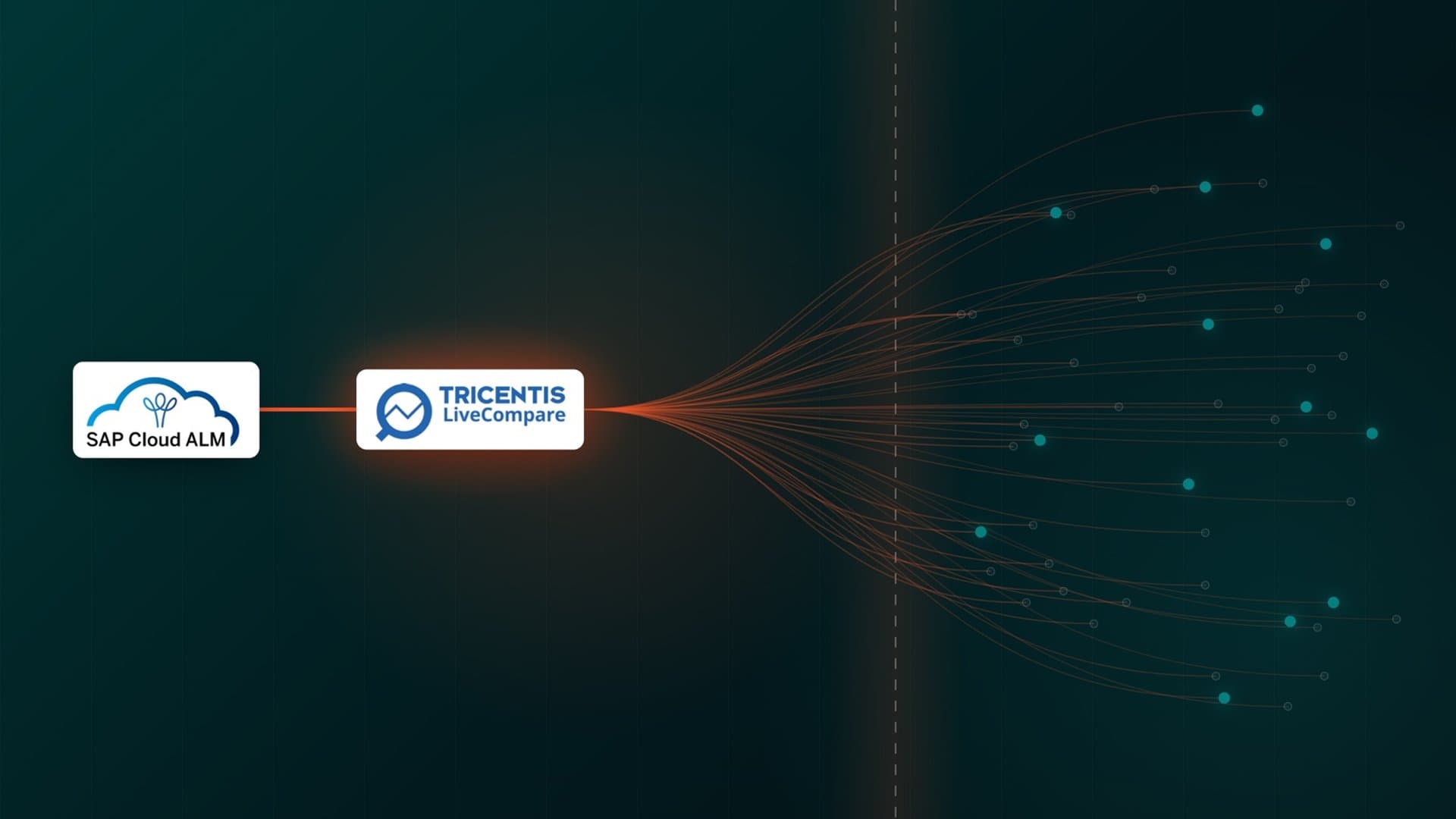
SAP Change Impact Analysis helps enterprises identify affected business processes, prioritize testing effort, and reduce unnecessary regression execution during SAP S/4HANA upgrades. Organizations commonly use Tricentis LiveCompare, SAP Cloud ALM, and automated testing frameworks to analyze transport changes, validate integrations, and strengthen release governance across SAP landscapes. Risk-based testing strategies improve release speed while reducing operational downtime and compliance exposure. Merito helps enterprises implement scalable SAP testing governance, optimize risk-based QA workflows, and renew SAP automation environments aligned with enterprise transformation objectives.
SAP DevOps practices improve migration outcomes by integrating automated testing, CI/CD orchestration, transport management, and governance visibility across SAP delivery pipelines. Enterprises commonly integrate SAP Cloud ALM, Azure DevOps, Jenkins, Tricentis Tosca, and SAP Solution Manager to improve release consistency and reduce deployment risk during S/4HANA transformation programs. Organizations also benefit from faster issue resolution and centralized operational reporting. Merito helps enterprises procure, implement, optimize, and renew SAP DevOps and QA ecosystems aligned with scalable modernization and business continuity goals.
Enterprises evaluating SAP testing and DevOps platforms should assess SAP application coverage, CI/CD integration support, governance capabilities, and operational scalability across hybrid enterprise environments. Organizations commonly compare Tricentis Tosca, SAP Cloud ALM, SAP Solution Manager, and automated testing ecosystems based on migration objectives and compliance requirements. Key evaluation areas include regression automation, risk-based testing, release orchestration, and centralized reporting visibility. Merito helps enterprises select, implement, optimize, and renew SAP QA and DevOps solutions aligned with long-term S/4HANA transformation and operational resilience strategies.
Keep Reading
Related Blogs
Explore a few more Merito insights that align with the themes in this article.
.jpg&w=2560&q=75)