
SAP regression automation with OpenText Functional Testing (formerly UFT One) starts with a reusable framework for critical business processes such as order-to-cash and procurement-to-pay. Pratt & Whitney's program aligned the framework with existing tools, automated email-based approvals and used Sprinter to capture test documentation as storyboard images. Standardizing on one framework across teams reduced duplicated effort.

Challenges
- Automate testing processes for critical SAP workflows to reduce manual effort
- Automate email-based approval processes to eliminate inefficiencies
- Standardize regression testing across teams to ensure consistency
- Align long-standing practices with modern automation tools and frameworks
Pratt & Whitney faced several roadblocks in their regression testing processes. Their reliance on manual testing and outdated workflows made it difficult to maintain efficiency and consistency across teams.
As a company known for precision and innovation in aerospace, Pratt & Whitney recognized the importance of bringing similar rigor to their software testing. However, their existing methods were fragmented, with no reusable automation framework in place, leading to duplicated efforts and missed opportunities for efficiency.
Additionally, long-standing workflows, heavily reliant on tribal knowledge, further complicated efforts to introduce modern tools and methods.
Pratt & Whitney’s challenges called for a comprehensive transformation to ensure their testing processes met the high standards of quality and efficiency that their operations demand
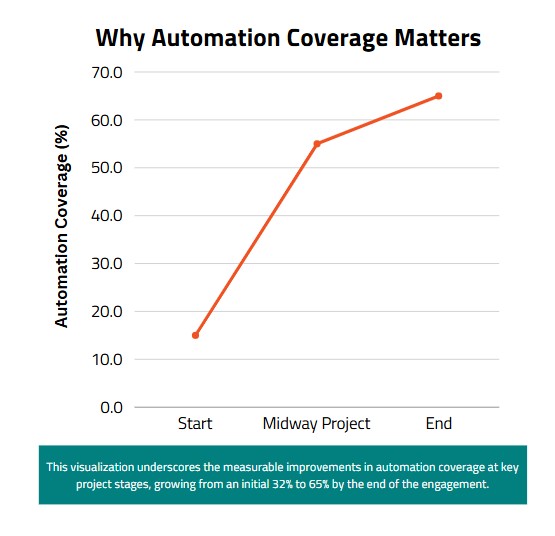
Why Automation Coverage Matters
In today’s fast-paced business environment, achieving high automation coverage is critical for ensuring consistent quality, reducing costs, and accelerating time-to-market. For businesses like Pratt & Whitney, whose operations impact global safety and efficiency, robust automation coverage offers several key advantages:
- Consistency and Reliability: Automated regression testing keeps core features locked down, so you can trust that updates won’t disrupt essential SAP workflows.
- Cost and Time Efficiency: By cutting out repetitive manual checks, your team frees up bandwidth for strategic work—driving down both effort and operating expenses.
- Scalability: As application complexity grows, a robust automation framework expands your testing capacity without compromising on speed or precision.
- Risk Mitigation: With broader automation coverage, you get faster feedback loops, catching defects early and steering clear of costly production issues.
For Pratt & Whitney, these benefits are especially significant. Their role in designing and maintaining advanced aerospace systems means that any inefficiency or error in their processes can have far-reaching consequences. By increasing their automation coverage to 65%, they have enhanced their ability to deliver safe, efficient, and reliable systems while streamlining operations.
Visualizing the Transformation
Solutions
Merito developed and implemented tailored solutions to address Pratt & Whitney's challenges:
- Regression Automation Framework:
- Delivered a automation strategy using UFT, aligned with their existing tools.
- Automated critical SAP workflows, including order-to-cash and procurement-to-pay processes.
- Established a reusable framework that reduced duplication and enabled consistent test execution. - Streamlining Approvals and Documentation:
- Automated the email-based approval process to accelerate decision-making and reduce delays.
- Introduced Sprinter, a tool that automated test documentation through storyboard images, saving significant time and effort. - Enhancing the Software Development Life Cycle:
- Refined the SDLC to increase efficiency and collaboration across teams.
- Enabled better backlog prioritization and alignment with business goals. - Driving Engagement Through Collaboration:
- Conducted workshops and hands-on training sessions to align team members with new tools and processes.
- Demonstrated the tangible benefits of automation to encourage adoption across teams.
Summary and Results
Merito addressed Pratt & Whitney’s challenges with a comprehensive approach, focusing on automation, workflow optimization, and collaboration. We implemented a robust regression testing framework using UFT, automated key SAP workflows, and streamlined their SDLC. The manual email-based approval process was replaced with an efficient, automated workflow, and tools like Sprinter were introduced to simplify documentation. Through hands-on training and collaboration, we aligned teams with modern testing practices, fostering a culture of innovation and consistency.
Pratt & Whitney experienced transformational outcomes from Merito's engagement:
- Increased Automation: Achieved 65% automation coverage, far exceeding their original goal of 45%
- Enhanced Efficiency: Regression cycles were streamlined, enabling faster issue detection and resolution
- Time Savings: Automation of approvals and documentation processes significantly reduced manual effort and accelerated deployments
- Cross-Team Collaboration: Other teams within the organization adopted similar automation practices, fostering a culture of innovation
Products and services used
Products
Solutions
Frequently Asked Questions
Start an implementation program
Turn a platform purchase into a productive, adopted system
If your team has bought (or is about to buy) a new enterprise platform and wants a program that runs it to go-live with integrations, workflows, and adoption ready, Merito can scope the implementation and start the discovery phase.