


01
See risk earlier
Understand which processes, objects, transports, and business flows deserve attention before testing starts.
SAP Testing
SAP changes rarely fail because teams lacked effort. They fail because process design, impact analysis, test coverage, automation, and release governance lived in separate places. A modern SAP testing model connects SAP Cloud ALM, SAP Signavio, Tricentis Tosca, Tricentis LiveCompare, OpenText Functional Testing, Panaya Change Intelligence, and the surrounding IT Factory workflows that keep SAP releases under control.
SAP Change Risk Landscape
A connected testing operating model shifts every cell toward Governed, before the release calendar compresses.
Validate critical end-to-end business processes
Scope testing based on actual SAP change impact
Connect process design, test management, automation, and release flow
Reduce regression risk during upgrades, migrations, and ongoing releases
Outcomes
A connected SAP testing model delivers measurable improvements across scope, coverage, automation, and release confidence.
Understand which processes, objects, transports, and business flows deserve attention before testing starts.
Reduce broad, unfocused regression cycles by aligning scope to actual business and technical impact.
Use the right automation strategy for SAP GUI, Fiori, browser flows, hybrid business processes, and cross-system validation.
Give program leadership, release managers, and business owners a clearer readiness view before go-live.
Solution overview
SAP testing is easy to oversimplify and expensive to get wrong. A single SAP release can change process flow, custom code behavior, integrations, Fiori screens, security roles, master data behavior, transport dependencies, and downstream reporting. That is why enterprise SAP teams need more than a batch of regression scripts. They need a connected testing operating model.
That model is what this solution builds. We align business process design, test traceability, impact analysis, automation, execution planning, and release governance so teams know what changed, what matters, what to test, and what is ready for production.
Problem to solution
Upgrades and major SAP changes introduce risk from multiple directions at once.
Problem and impact
A process that looked stable in design workshops can behave differently once the upgraded configuration, custom logic, and security model are active.
Merito response
Merito aligns process design in Signavio with implementation and testing in Cloud ALM so teams can trace behavior from design intent to release evidence.
Problem and impact
Fiori behavior, browser interactions, and role-driven launchpad paths can change enough to break manual expectations and brittle automation.
Merito response
Resilient automation separates business intent from implementation detail, so Fiori and UI changes do not collapse regression suites.
Problem and impact
Remediated code, changed objects, and transport sequencing can alter impact far outside the originally assumed scope.
Merito response
LiveCompare and Panaya help narrow the blast radius and align testing effort to the parts of the landscape that actually carry risk.
Problem and impact
The business process rarely stops at SAP. Integrations with ITSM, DevOps, middleware, reporting, identity, and third-party systems often determine the real release risk.
Merito response
Merito connects SAP testing workflows into the surrounding delivery motion including work tracking, ITSM, release processes, and governance.
Problem and impact
Teams lose time when requirements, process models, test cases, automation assets, and defect signals live in disconnected tools and ownership silos.
Merito response
Cloud ALM and Signavio create the coordination backbone while Merito helps connect the surrounding toolchain into one testing operating system.
Problem and impact
Under deadline pressure, organizations widen or shrink testing based on instinct instead of evidence. That is where avoidable production risk enters.
Merito response
With release-readiness criteria, governance dashboards, and decision points in place, go-live confidence comes from evidence rather than hope.
Capabilities
Merito supports the full range of SAP testing needs from strategy through ongoing operations.
We define the target testing model, role ownership, environment approach, traceability model, automation boundaries, and release governance needed for the client's SAP delivery pattern.
We help align process design, implementation work, test assets, and reporting so the process layer and the testing layer reinforce each other.
We design or extend SAP automation with Tosca, OpenText Functional Testing, or other agreed tooling based on environment realities, business process criticality, and team maturity.
We help clients use tools like LiveCompare and Panaya to focus effort where SAP risk is concentrated.
We support S/4HANA upgrades, support packs, transport-heavy release cycles, and ongoing SAP change programs with stronger scoping, execution planning, and readiness reporting.
We support internal teams with hands-on enablement, governance, tuning, framework cleanup, execution support, and ongoing optimization.
Operating model
Step 1
We identify the end-to-end business flows, integrations, environments, and ownership layers that define real SAP release risk.
Step 2
We align process design, requirements, and testing structure so teams can trace decisions from business flow to release evidence.
Step 3
We evaluate what changed, where it changed, how far it reaches, and which processes deserve the highest testing priority.
Step 4
We determine where reusable automation creates the most leverage and where manual execution still serves the release best.
Step 5
We run testing with clearer decision points, defect flow, reporting, and release-readiness criteria.
Step 6
After go-live, we help teams refine scope, improve maintainability, tune dashboards, and strengthen the long-term SAP testing model.
Platform ecosystem
Each tool in the SAP testing ecosystem plays a specific role. The strongest outcomes come from tool connection, not tool accumulation. SAP testing workflows should connect into the rest of the delivery motion.
SAP testing ecosystem coverage



Services
Platform security
SAP systems carry sensitive business data, financial transactions, and identity infrastructure. SAST and DAST coverage has to extend across SAP landscapes so security validation keeps pace with functional testing.
Security validation
SAP applications expose a broad and often underestimated attack surface. Fiori launchpads and apps serve as the primary user interface for S/4HANA, and every Fiori endpoint, OData service, and ICF handler is a potential entry point for injection, session hijacking, or privilege escalation. Behind the UI, custom ABAP code, RFC-enabled function modules, BAPI interfaces, and role-based authorization models introduce risk that standard web application scanners are not designed to detect.
Most enterprise security programs treat SAP as a black box. Vulnerability scans run against perimeter infrastructure but skip the application layer entirely, or rely on generic DAST tools that cannot authenticate through SAP login flows, navigate Fiori tile structures, or exercise OData entity sets. The scan completes and the report looks clean, but the actual SAP attack surface was never tested.
Merito integrates static and dynamic application security testing directly into the SAP testing operating model. SAST tooling analyzes custom ABAP code and Fiori front-end sources for injection vulnerabilities, hardcoded credentials, missing authorization checks, and insecure data handling patterns. DAST tooling is configured to authenticate against SAP systems, crawl Fiori apps and OData endpoints, and test for cross-site scripting, CSRF, broken access control, and server-side request forgery in the context of real SAP user roles and transactions. Security findings are linked into Cloud ALM release governance and remediation is tracked through the same transport and release cycle that governs functional changes, giving security teams and release managers a unified view of what is ready and what is not.
What we test
Merito focus areas
Scenarios
SAP testing programs vary by trigger, scope, and urgency. These are the most common scenarios where Merito engages.
You are moving from one S/4HANA version to another and need a clearer view of impacted processes, custom objects, and regression scope before the release calendar compresses.
You need a testing model that supports process redesign, hybrid automation, data and integration validation, and leadership-grade readiness visibility.
You need to validate user paths, role-driven behavior, browser interactions, and end-to-end process continuity across SAP and non-SAP systems.
You need a more disciplined way to connect transports, change analysis, test planning, and release gating.
You want Cloud ALM, Signavio, automation, and surrounding toolchain workflows to behave like one release system instead of several disconnected admin surfaces.
You completed the upgrade, but execution remains noisy, regression remains wide, and every release still feels larger than it should.
Outcomes
Impact-based scoping reduces unfocused regression by aligning effort to where SAP risk is actually concentrated.
Reusable automation and smarter prioritization compress regression timelines without increasing coverage gaps.
Governance dashboards and release gates give leadership evidence-based confidence instead of gut-feel go-live decisions.
Process design, testing, change intelligence, and release workflows operate as one system instead of disconnected activities.
Why Merito
Clients need more than implementation help. They need a partner who can align process, tooling, automation, and release operations.
Merito can help clients use Cloud ALM-centered testing models, vendor-specific accelerators, or hybrid tool environments without forcing every program into the same pattern.
The outcome is not more test cases. The outcome is better production confidence during upgrades and ongoing SAP change.
We can help design the model, implement it, enable the team, and support ongoing execution maturity.
Merito supports blended offshore delivery for cost-efficient execution or fully US-based resources when proximity, time zone alignment, or compliance requirements demand it.
Consultation
Whether you are planning an S/4HANA upgrade, tightening transport governance, modernizing your SAP testing model, or trying to reduce regression effort without increasing risk, Merito can help you build a cleaner path to release readiness.
Leadership visibility
Merito's point of view is simple. SAP testing performs best when process design, release planning, change intelligence, test management, automation, and execution governance work as one operating system.
For many clients, that means using SAP Signavio for process design, SAP Cloud ALM for solution process traceability and test orchestration, then extending outward into testing platforms, ITSM tools, work management tools, and reporting layers. The result is an SAP-centric IT Factory that supports both transformation programs and ongoing release management.
Merito can support Cloud ALM-centered models, hybrid tool stacks, or a phased journey from fragmented testing into a more governed operating model.
SAP transport governance and release readiness
Transport Governance
SAP release risk is deeply tied to transport sequencing, custom code changes, and cross-system dependencies. Without structured governance, teams lose visibility into what moved, what broke, and what still needs validation.
Merito integrates change intelligence from tools like LiveCompare and Panaya into the testing operating model so transport impact is visible, scoping decisions are evidence-based, and release gates reflect actual risk rather than estimated effort.
Release Readiness
Enterprise SAP programs need release confidence built on evidence, not on test volume alone. That means connecting process validation, regression results, defect resolution, and readiness criteria into a single governance view.
Defined readiness criteria, governance dashboards, and decision points keep go-live calls tied to actual release state rather than subjective assessment.
Proof
Pratt & Whitney
65% automation coverage against an original goal of 45%, with critical SAP workflows such as order-to-cash and procurement-to-pay automated in OpenText Functional Testing (UFT).
Enterprise SAP go-live
Load, stress and spike testing for 500 simultaneous SAP logins, from requirements to go-live evidence in about three weeks, with OpenText LoadRunner Enterprise.
Frequently Asked Questions
Consultation request
If you need help building an SAP testing strategy, reducing upgrade risk, connecting your tool stack, or strengthening release governance, start the conversation here.
Assessment
Evaluate your current testing model, tool stack, traceability, automation coverage, and release governance to identify gaps and improvement priorities.
Implementation
Design and implement a connected SAP testing model across process design, test management, automation, impact analysis, and release readiness.
Get Started
Tell us about the SAP upgrade or release you are planning. A Merito SAP testing specialist follows up within one business day.
Next step
Merito helps enterprise SAP teams reduce upgrade risk, strengthen regression coverage, and release with confidence across S/4HANA, transports, Fiori, and ongoing change delivery.
How to check what your last transport changed, why teams test everything without that answer, and how change impact analysis narrows regression scope.
Related Resources
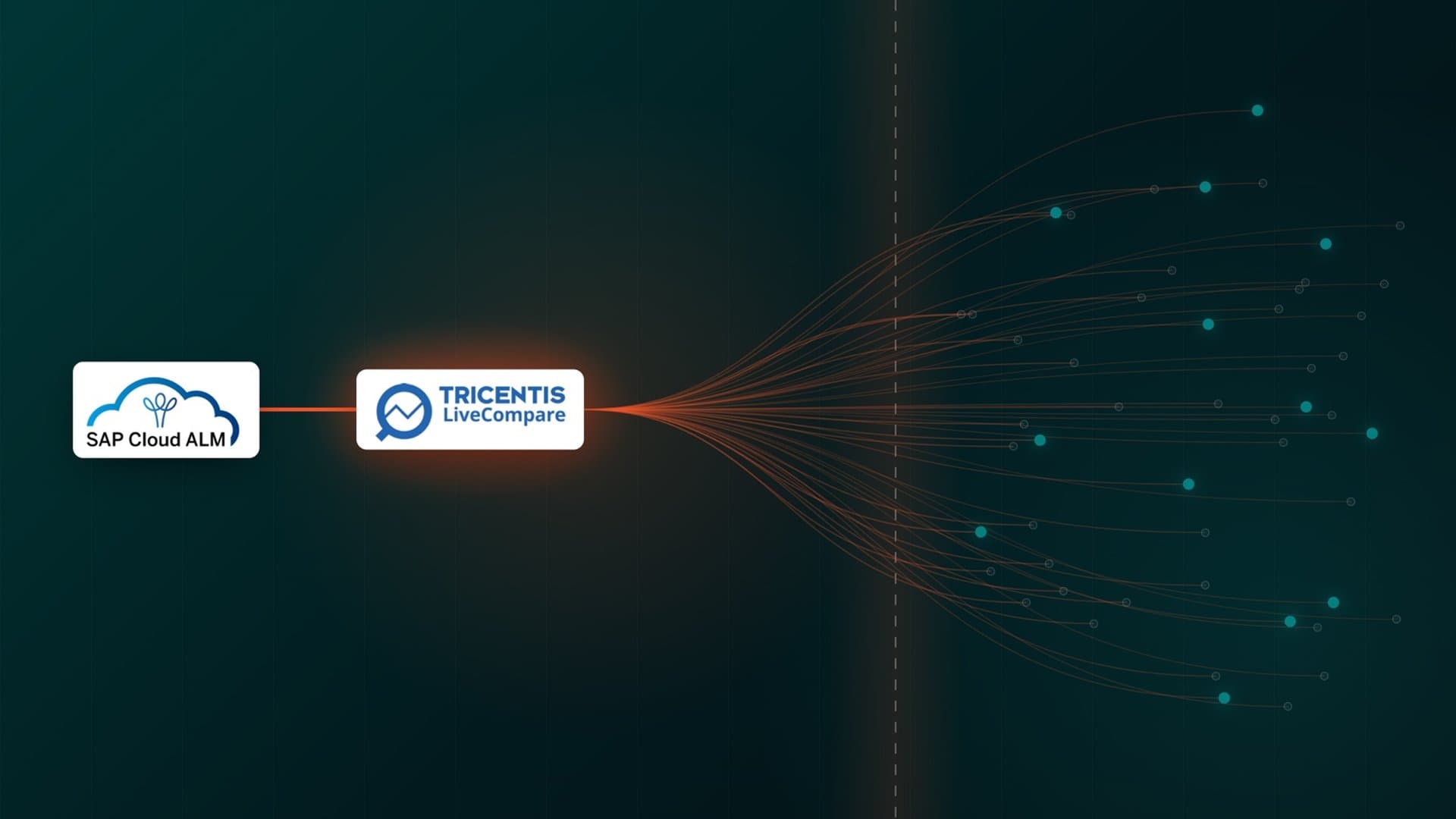
SAP Change Impact Analysis (CIA), sold by Tricentis as LiveCompare, reads a transport, support pack, or upgrade delta and resolves every dependent object down the call structure, standard SAP code included. It weights that dependency graph with production usage so objects nobody calls drop out of scope, then matches the result against test repositories such as Tosca, qTest, or Solution Manager to return covered objects and coverage gaps. Run on every transport cycle it makes a SAP Cloud ALM release gate enforceable instead of a signature field.
A business case for SAP change impact analysis should rest on five numbers the team produces itself: the fully loaded cost of one regression cycle, the number of cycles run per year, the share of test cases that exercise an object a transport actually changed, a scope reduction the team would defend to a CFO, and the price of one escaped defect. Vendor-published ROI percentages collapse under finance scrutiny because they trace back to a product page rather than the buyer's own program, and the escaped-defect line is usually the largest item in the model.

Learn how to implement Claude with governance, workflow integration, security controls, and measurable business outcomes across engineering, QA, DevSecOps, and enterprise applications.

Security teams need more than code scanning. Explore how deepsec fits into a modern AppSec strategy with ASPM, DevSecOps governance, and layered validation.

AI test case generation in tools like TestRail, qTest, and Xray makes cases nearly free to produce, so suites grow faster than teams can review, run, or maintain them. The fix is a scenario gate: define risk-based test scenarios first, have an accountable owner approve them, and generate cases only inside approved scenarios with a per-scenario cap and deduplication. Every case then traces to a requirement and a risk, which gives leaders real release evidence and shows which manual cases deserve automation first.
Checkmarx Fusion is a hybrid vulnerability detection layer in Checkmarx One that combines deterministic, rules-based SAST with a language-agnostic AI engine and curated frontier AI models, reconciled into a single result set. Checkmarx reports an F1 score of 0.741, versus roughly 0.20 for legacy rule-based SAST, and describes the approach as producing consistent results across scans while extending coverage to vulnerabilities with no existing rule or CVE.