A test management software purchase is a delivery operating decision. It affects how teams plan tests, connect requirements to evidence, bring automated results into release reporting, and explain risk to leaders. The best choice fits the way work moves through your organization.
A feature checklist still has value. It becomes useful only when it is tied to business needs, delivery risks, and the daily work of QA, development, DevOps, and release teams.
Start with the operating model
Test management needs a structure that reflects the business. A global enterprise may have divisions, product lines, shared platforms, and local delivery teams. Each group may need its own test suites, releases, user journeys, and reporting views.
Define how the platform must organize:
- Products, programs, and projects
- Test suites, test cases, and test runs
- Manual, automated, exploratory, integration, and user interface tests
- Release milestones and risk-based test scopes
- Ownership across teams and business units
This structure drives governance. For example, a payments platform team may own shared integration tests, while each product team owns its release tests. Leaders need a roll-up view of coverage and execution. Engineers need a focused view of the tests that affect their service.
A demo should test this model with your own examples. Generic sample projects rarely reveal whether the tool will remain manageable after several release cycles.
Treat access as a governance requirement
Access is more than user setup. It controls who can view quality evidence, update test assets, approve release information, and administer the platform.
Evaluate single sign-on, role-based permissions, user lifecycle management, and licensing assumptions. A tool may serve testers well while creating friction for developers, product managers, security engineers, or leaders who need read access to release status.
A practical goal is broad visibility with controlled change rights. A release manager may need to see all open risk areas. A contractor may need access only to a defined project. A test lead may need authority to archive obsolete tests and maintain standards.
Map the flow of engineering data
Test data often lives across requirements systems, defect trackers, source control, automation code, CI/CD pipelines, and team documentation. The key question is which information must move between these systems to support decisions.
Map the required links before evaluating a tool:
- Requirements or work items linked to test cases
- Defects linked to failed executions
- Build and commit context linked to automated results
- Test evidence linked to release milestones
- Supporting documentation linked to test strategy and scope
This mapping supports traceability. In a regulated release, a quality leader may need to show that critical requirements were tested, results were reviewed, and open defects were considered before approval. In a fast delivery team, the same links help developers find the failed test, related defect, and affected build without manual searching.
For an objective view of platform models, review test management tools compared. The right model depends on where your teams already manage work, defects, and release evidence.
Validate CI/CD and API support with real results
Automated testing produces value when its results are visible in the release process. CI/CD integration and APIs allow pipeline results to be tied to planned test coverage and reported alongside manual work.
A mature proof of concept should submit real automated results from a pipeline. It should show how those results map to test cases, how failures appear in reports, and how teams handle retries and reruns.
This matters in several ways:
- QA teams can see automated and manual execution in one release view.
- DevOps teams can track results over time and identify recurring failures.
- Release managers can distinguish a failed pipeline task from a failed business test.
- Security, performance, accessibility, and end-to-end test data can inform the same risk discussion.
Teams should also check whether APIs support required data imports, exports, and connections to internal reporting tools. Implementation services can help define these integration paths before configuration begins.
Demand reporting that supports decisions
Executive reporting should answer clear questions: Are we ready to release? What remains untested? Which requirements lack coverage? Where are critical defects concentrated? Is quality improving or declining over time?
Different roles need different views. A CTO may need trends across products and quarters. A QA director may need coverage, workload, execution status, and defect patterns by program. A delivery team needs a current view of the active release.
Evaluate dashboards and reports for their ability to show:
- Test execution status and completion trends
- Requirement and reference coverage
- Defect links and failure patterns
- Release and milestone status
- Workload across teams
- Results over selected time periods
Reports should reduce manual spreadsheet work. They should give leaders evidence for scope, timing, and risk decisions. Managed services can support report design and ongoing administration when multiple teams share a common test management platform.
Prove scale, migration, and test asset control
Scale is about more than the number of test cases. Enterprise environments create large volumes of execution history, automated results, users, projects, attachments, and reports. The evaluation must confirm that search, filtering, permissions, and reporting remain useful as this volume grows.
Migration deserves the same care. Assess supported import and export formats, field mapping, test step handling, attachments, history needs, and repository structure. Confirm that your organization can retain evidence and retrieve it later.
Test case management also needs clear lifecycle controls. Teams should be able to archive old tests, restore valid assets, move tests between teams, adjust priority, and change scope based on release risk. These controls help prevent stale test repositories from creating false confidence.
Use a weighted scorecard and proof of concept
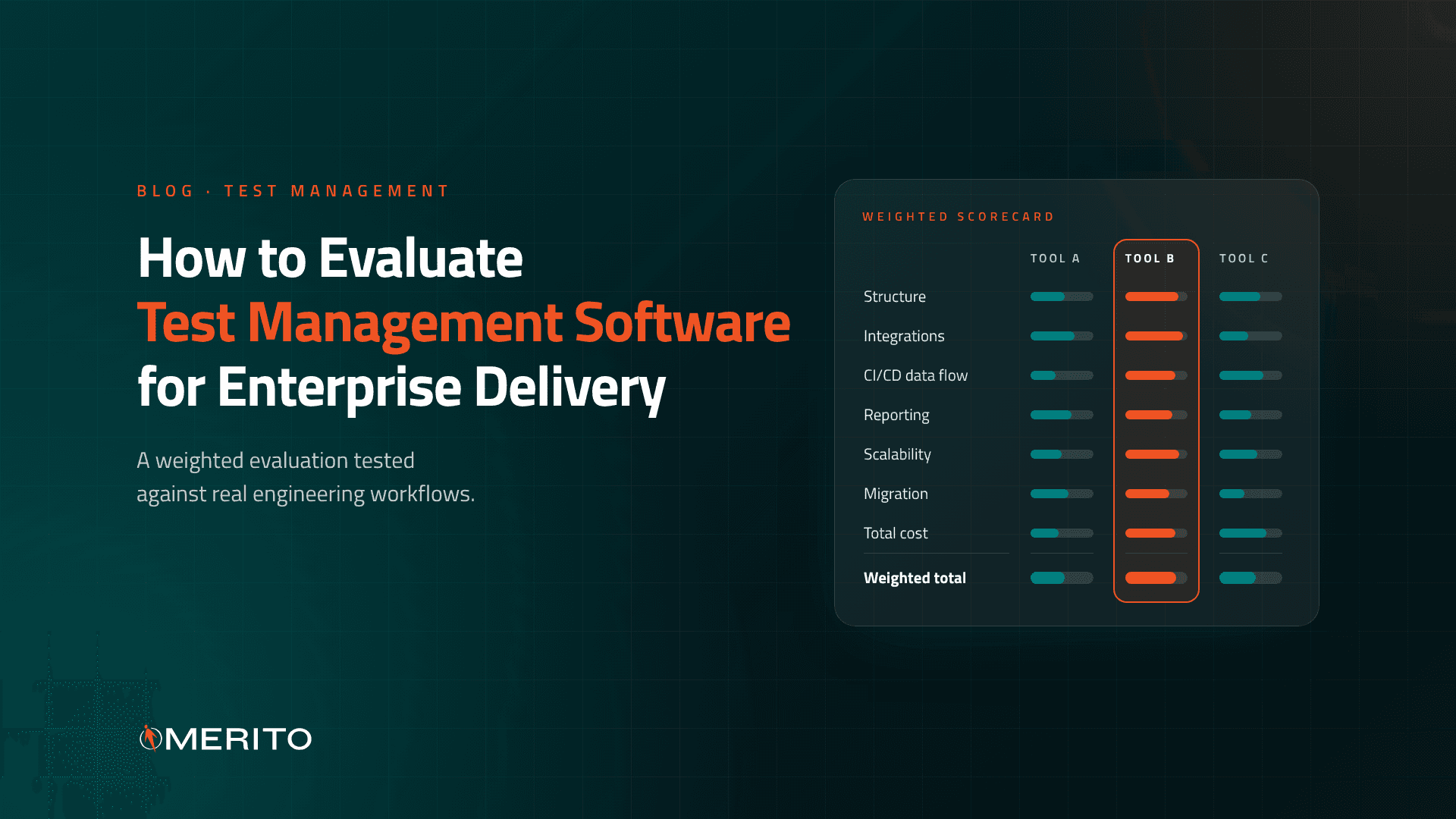
A weighted scorecard prevents teams from choosing a tool that scores well on minor features while missing a critical requirement. Give strong negative weight to a missing capability that would force manual work, break traceability, or block a required delivery process.
Then test the short list through a proof of concept. Include real users from QA, engineering, DevOps, security, and release management. Use a representative release workflow and ask each role to complete its daily tasks.
The proof of concept should validate:
- Structural fit for products and teams
- Access and permission models
- Requirements, defect, and CI/CD integrations
- Automated result ingestion
- Reporting for delivery and executive decisions
- Data migration and export paths
- Administration effort and total cost
Training also affects adoption. Training and enablement helps teams establish consistent practices for test design, execution evidence, reporting, and platform administration.
Make the selection a delivery decision
The right test management platform creates a trusted record of test scope, results, defects, and release risk. It gives practitioners usable workflows and gives leaders evidence for decisions that affect customers, compliance, and delivery commitments.
Merito helps enterprise teams fast track selection and adoption through three practical steps: define weighted requirements with cross-functional stakeholders, run a proof of concept using real workflows and data, and establish a governed implementation plan for integrations, migration, training, and reporting. These actions reduce selection risk and create a stronger foundation for enterprise QA, DevOps, and DevSecOps delivery.