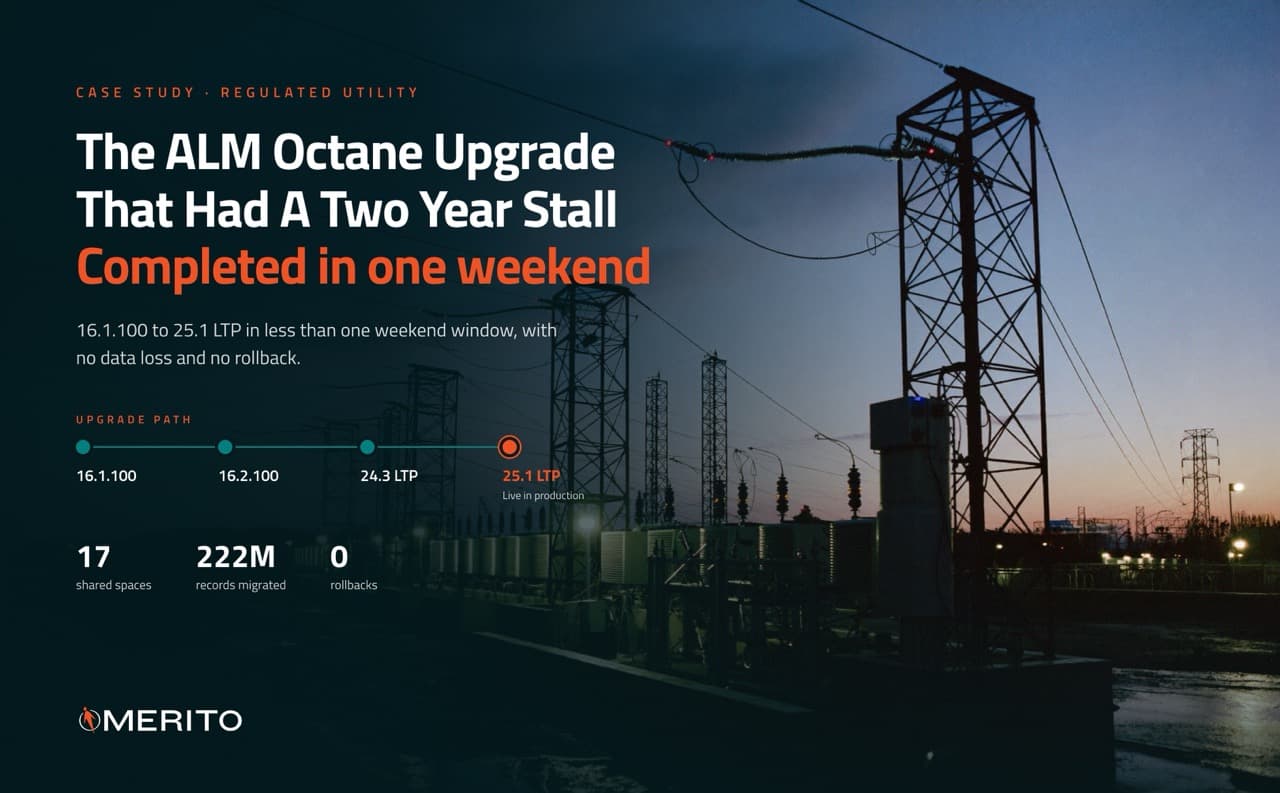
Yes. Merito took a regulated electric utility's production ALM Octane platform from 16.1.100 to 25.1 LTP inside one approved change window, in less than one weekend. The work covered three release hops, two Elasticsearch upgrades, a move from JDK 11 to JDK 21 and new Windows Server 2022 hosts. All 17 shared spaces and 222 million records came through with no data loss and no rollback.
Merito took a large, regulated electric utility's OpenText ALM Octane platform from 16.1.100 to 25.1 LTP in production inside one approved change window, and moved it onto new Windows Server 2022 infrastructure along the way. All 17 shared spaces and the hundreds of child workspaces beneath them, each with its own business rules, field configurations and integrations, went back into service. Over 222 million records moved with no data loss, and no rollback was needed.
One single Merito engineer carried the entire technology stack, from applications, servers and networking to databases, search, encryption, certificates and single sign-on. That engineer recommended the upgrade path, facilitated the technical discussions and helped the utility build the plan that guided the project. Where earlier upgrade attempts had stalled, Merito delivered.
At a Glance
- Customer Large regulated electric utility, name withheld
- Industry Utilities
- Platform OpenText ALM Octane, now named OpenText Software Delivery Management
- Upgrade path 16.1.100 to 16.2.100 to 24.3 LTP to 25.1 LTP
- Search engine Elasticsearch 7.16 to 7.17 to 8.11
- Java runtime JDK 11 to JDK 21
- Infrastructure Windows Server 2016 to Windows Server 2022, original IP addresses retained
- Scope 17 shared spaces, hundreds of child workspaces, 222 million records, 192 search indices, 230 GB file repository
- Merito delivery One engineer as technical lead, architect and hands-on delivery across the full stack
- Outcome Delivered inside the approved change window, no data loss, no rollback required
The Challenge
The utility uses ALM Octane heavily and has built up a large amount of valuable delivery data in it over the years. That same depth of use is what made the platform hard to move. The environment had never been current on a modern long-term path (LTP) release, and earlier upgrade attempts had stalled, leaving abandoned upgrade records in the system dating back to 2023.
The utility already had its own DevOps, DBA, cyber security, network and hosting teams on the platform, plus a global system integrator as its managed services provider. The earlier attempts were run by that integrator with help from OpenText Support resources. What the utility needed was hands-on support from someone who would work inside its IT policies, which add steps, approvals and wait time to every change, and keep the upgrade moving anyway.
The scale is easy to understate. The utility runs 17 shared spaces, and each one operates almost like its own business, with its own rules, field configurations, workflows and integrations, and hundreds of child workspaces beneath them. Every one of them had to come through the upgrade intact and behaving exactly as its users expect.
Getting current meant moving five layers in sequence on production. The Octane application had to go through three release hops. Elasticsearch had to go through two upgrades and onto a new major version. The Java runtime had to jump from JDK 11 to JDK 21. The database schemas had to change underneath all of it. And the servers themselves were running on an operating system approaching end of support. Every step had to fit inside the utility's change control process, privileged access controls and network security layers, all of which exist for good reason at a utility.
The utility brought Merito in to plan, rehearse and lead the upgrade end to end, the full scope of Merito's enterprise platform upgrade services.
Why This Project Was Different
A typical Octane upgrade is one hop on a clean environment. This one was three hops, two Elasticsearch upgrades that crossed a major version and a Java runtime change, on a platform carrying years of accumulated data, while also moving DEV and production onto new server infrastructure. Prior maintenance and upgrade cycles had left orphaned indices, stale reindex artifacts and legacy records behind, including an 8 GB index belonging to a workspace that no longer existed. The issues that had stopped earlier attempts were still unresolved when Merito arrived.
One Merito Engineer with the Whole Stack
An upgrade like this normally takes a room full of specialists. An application engineer, a Windows server administrator, a network engineer, a database administrator, a search engineer, a security and certificates engineer, an identity engineer, and someone to automate, analyze and report on all of it. On this project, a single Merito engineer covered every one of those disciplines.
- Applications. Octane installation, configuration and per-space upgrades across every application node
- Servers and networking. New host builds, infrastructure cutover and network interface cutover
- Databases. Schema and maintenance validation, backup coordination and point-in-time recovery planning
- Search. Elasticsearch upgrades, index cleanup, health, backup and recovery
- Security. SSL certificates, certificate validation, Java keystores and encryption
- Identity. Single sign-on configuration and troubleshooting
- Automation and analysis. Purpose-built tooling, forensic troubleshooting and executive reporting
Merito built the plan. The Merito engineer recommended the upgrade path, facilitated the technical discussions and helped the utility build the plan that guided the entire program. That plan covered the upgrade path and sequencing, the full production-replica rehearsal strategy, the infrastructure refresh, the backup and rollback approach at every checkpoint, the database access model, and the single sign-on re-integration. Every runbook, playbook and status report came from Merito.
The utility's teams kept full ownership of their systems and approvals. What changed is that every request reaching them from Merito was already diagnosed, specific and ready to approve, which kept the whole program moving.
Our Approach
Analyze every requirement before the first command. Merito worked through the OpenText upgrade guidance for every hop and turned it into a single execution playbook of more than 200 timed activities across six phases, each with an owner and a rollback. That analysis surfaced steps the vendor guides did not spell out, including a configuration merge in 25.1 that, if missed, would have silently discarded production settings.
Rehearse on a full production replica. Before touching production, Merito restored the utility's production data into DEV and rebuilt the environment as a full replica, with all 17 shared spaces and hundreds of child workspaces. DEV became a dress rehearsal for production night and the proving ground for the critical repair steps that had blocked earlier upgrade attempts. The 16.1.100 to 16.2.100 rehearsal closed out in April 2026 with all 17 shared spaces upgraded and validated. In May 2026, DEV went live on Octane 24.3 LTP, Elasticsearch 8.11 and JDK 21, the first time the utility had ever run a 24.3 LTP release.
Documented the plan so it could be verified. Merito produced phase-by-phase runbooks with a defined rollback at every stage, an Elasticsearch backup guide specific to the utility, and a production server readiness guide backed by batch scripts that configured every new host the same way.
Protect the data at every checkpoint. Database, file repository and Elasticsearch snapshot backups were coordinated at each checkpoint, with point-in-time recovery available throughout. Every database change ran with automated safety controls that abort and reverse themselves if they would touch more records than intended.
The Merito Octane Upgrade Toolkit
A large production upgrade can have every technical step right and still fail on time, when manual checks and log hunting eat the change window. Merito built a command-line toolkit across repeated DEV cycles that turned hours of manual work into minutes.
- Pre-flight evaluation of Elasticsearch and database health, including schema checks and a full inventory of every search index
- Elasticsearch cleanup that found and removed orphaned indices left behind by deleted workspaces and earlier failed reindexes, and cleared legacy indices created under Elasticsearch 6, which Elasticsearch 8.11 cannot open and which would otherwise have blocked the upgrade
- Automated, validated backups of Elasticsearch and the database before every hop
- Recursive log parsing across every node, surfacing the errors that matter from millions of log lines in seconds
- Post-upgrade revalidation with a report for every health check and upgrade step
The toolkit compressed the production timeline and was the deciding factor in finishing inside the approved window. It is now a reusable Merito asset for Octane customers facing the same path. To use it on your own upgrade, ask Merito about the Octane upgrade toolkit.
New Infrastructure, Same Addresses
The utility's Octane servers were running Windows Server 2016, which reaches end of extended support in January 2027. Merito flagged the risk early and folded an infrastructure refresh into the upgrade, which saved the utility a second project to fund and schedule.
New Windows Server 2022 hosts were built and readied with scripted, consistent configuration. Merito then ran the infrastructure and network interface cutover so the new servers took over the original IP addresses, meaning integrations, firewall rules and users saw no change. Octane and Elasticsearch were reconfigured for the new hosts, and the 230 GB file repository was transferred and verified on the new infrastructure.
Challenges We Worked Through
A single sign-on failure hidden behind the firewall. After the DEV rebuild, users could sign in with a local account, but single sign-on failed the moment the identity provider handed them back to Octane. How long the underlying condition had existed is unclear, and the usual suspects, the identity provider, the SAML setup and the load balancer, all checked out. Merito ran a forensic analysis of captured browser network traffic, traced each login request step by step, and pinpointed the utility's web application firewall as the point of rejection. A new authentication handshake introduced in Octane 24.3 was being blocked as unrecognized traffic. Merito worked with the utility's networking and architecture teams to allow that one authentication URL, with every other firewall protection left in place.
Java 21, encryption keys and the existing SSO configuration. The JDK 11 to 21 move meant the new Java keystore could no longer decrypt the existing SSO configuration. Merito caught this in DEV and re-scoped SSO as a fresh integration with user cleanup in site admin, so it never became a surprise on production night.
Database access under strict separation of duties. The utility's standard is that production database credentials stay with the DBA team. The upgrade toolkit needed to repair maintenance databases iteratively during the window, and relaying every command through a screen share would have put the window at risk. Merito designed a controlled model using Octane-specific admin and application accounts, the same model already proven in DEV, and worked it through the utility's cyber security and DBA teams so it was validated before the window opened.
Years of search maintenance meet the vendor upgrade path. Years of Elasticsearch maintenance history, combined with how the Octane upgrade path processes search indices, produced failures no documentation anticipated, including an index analyzer rewritten during the 16.2.100 per-space upgrade and a reindex naming collision that blocked automatic recovery. Merito diagnosed each one, documented it with a full evidence pack for OpenText, and built a remediation runbook that is reusable for other customers on the same path. Merito also caught a latent issue that would likely have gone unnoticed for months.
Search engine faults that never appeared in DEV. Production surfaced four Elasticsearch faults that DEV had not. Because the rehearsal had already exposed this class of failure, Merito recognized the patterns in minutes. The Merito toolkit checked the true state of all 192 indices on demand, independent of the product's own reporting, against a documented configuration baseline. All four were diagnosed and resolved inside the window.
Infrastructure and access friction. Merito absorbed a flaky production app server that had to be rebuilt, new production hosts with no internet access, and a Windows service enabled by mistake that was holding the port Octane needed to start. Merito found that one in DEV and added it to the production checklist. During the window itself, more than two hours went to privileged access login failures, plus an account lockout tied to an 8-hour password vault rotation. The window held anyway.
Results
- Octane 25.1 LTP live in production across all application nodes
- Elasticsearch 8.11 and JDK 21 in service, with orphaned and legacy Elasticsearch 6 indices cleared
- Production moved onto new Windows Server 2022 infrastructure with original IP addresses retained and the 230 GB file repository migrated intact
- All 17 shared spaces and their child workspaces upgraded and functionally validated for login, search, attachments, record access and single sign-on
- 222 million records migrated with no data loss, in less than one weekend window
- Delivered inside the approved change window with no rollback required
Business Impact
Lower platform risk. The utility is now on a supported long-term path release with a current search engine, Java runtime and server operating system, well ahead of the Windows Server 2016 end-of-support date, and has a clean baseline for future maintenance.
Access to current capabilities. The utility's teams now have the features and functionality Octane provides through 25.1.
One engineer, the whole stack, one point of accountability. The utility had a single Merito engineer who recommended the path, helped plan the program and delivered every layer end to end, in place of separate application, infrastructure, network, database, search and security specialists to assemble and coordinate.
A repeatable path forward. The environmental debt found along the way has been cleaned up or scheduled for removal, and every lesson from this upgrade went into the Merito playbook and toolkit, so the next release should be faster and lower risk than this one.
A tested way of working. The utility's DevOps, DBA, cyber security, network and hosting teams now have a documented, rehearsed approach for running a complex production change together, including a database access model that respects separation of duties.
Working Together
Merito worked day to day with the utility's IT transformation and DevOps teams, including its managed services provider, along with the DBA, cyber security, network, hosting and identity teams. Leadership tracked the program through a single Merito-built status view showing every step, owner and risk rating, and written updates went out through every phase with accomplishments, next steps, blockers and specific asks for each team, so nobody had to guess where things stood. When the original production window moved, Merito used the time to finish production server readiness and rehearse the playbook again.
If Your Upgrade Has Stalled
The path this utility took is repeatable. The playbook, the rehearsal method and the toolkit are reusable Merito assets, and they apply to an ALM Octane environment that is several releases behind or still carrying leftovers from an earlier attempt. Your own teams and your managed services provider keep ownership of systems and approvals, the way they did here.
Merito is an authorized OpenText reseller and services partner. For teams still on the older platform, Merito has also written up how it handles OpenText ALM and Quality Center upgrades, and upgrades are one part of Merito's work across the enterprise DevOps toolchain.
If an upgrade is stuck, or you have been told it cannot be done inside your change window, talk to an upgrade specialist.
Merito is a Value-Added Partner delivering AI-powered, secure, efficient and lasting enterprise solutions in AppSec, Quality, and DevSecOps.
Frequently Asked Questions
Start an implementation program
Turn a platform purchase into a productive, adopted system
If your team has bought (or is about to buy) a new enterprise platform and wants a program that runs it to go-live with integrations, workflows, and adoption ready, Merito can scope the implementation and start the discovery phase.