Performance Testing a $50M SAP Deployment in 3 Weeks
Customer Impact
Performance Testing a 50M SAP Deployment in 3 Weeks
This case study covers how Merito validated a $50M SAP deployment for go live in approximately three weeks, with no existing performance baseline. It details the load, stress and spike testing strategy, a mid engagement tool pivot to OpenText LoadRunner Enterprise, and how the team solved SAP session token and licensing issues under a fixed deadline.
Technology: OpenText LoadRunner Enterprise, VuGen and Analysis
The Business Challenge
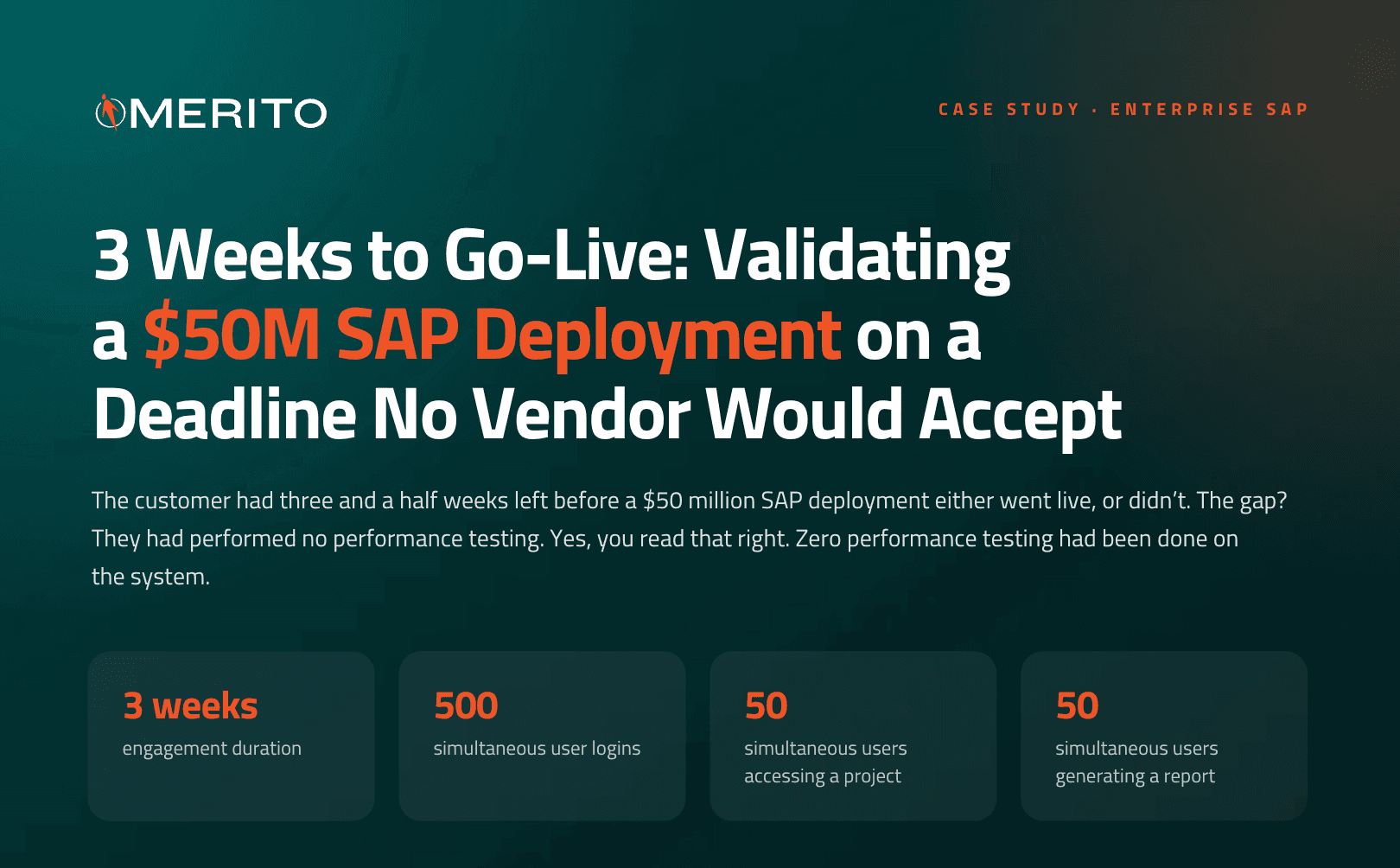
The customer had three and a half weeks left before a $50 million SAP deployment either went live, or didn't. The gap? They had performed no performance testing. Yes, you read that right. Zero performance testing had been done on the system.
They needed to establish whether its SAP environment had been appropriately sized for production and whether it could support three critical scenarios:
500 simultaneous user logins
50 simultaneous users accessing a project
50 simultaneous users generating a report
The customer had already spent months looking for a provider that could deliver the work as a focused engagement. Most organizations they approached wanted to establish a longer term performance testing program. There simply was no time for that.
The challenges:
No existing performance baseline
An aggressive timeline
No room for tool delays
Complex SAP testing conditions
Licensing and product issues
Merito took on the engagement with approximately three weeks to define the requirements, establish the testing strategy, procure and configure the technology, build the scripts, execute the tests and deliver the final findings.
The Solution: A Performance Strategy Built Around the Business
Merito used the customer's current and anticipated user behavior to create a broader performance strategy. The testing included:
Load testing
Stress testing
SAP
SAP Testing
Test Automation
OpenText
Spike testing
Ramp testing
Multiple workload levels from low load through extreme stress
We also planned endurance testing, although the compressed timeline meant there was ultimately not enough time to execute it.
Testing Realistic User Behavior: for the 500 user login requirement, we created workloads that reflected more realistic behavior. The strategy included 200 simultaneous logins followed by 300 users arriving progressively. We also tested five batches of 100 users over approximately ten minutes to represent a typical morning start period. This allowed us to understand not only whether the system could withstand a spike, but how it behaved as users progressively entered the environment.
Testing Beyond the Expected Maximum: The customer's expected future growth was also incorporated into the workload design. We tested beyond the anticipated maximum to understand how the environment behaved under significantly higher demand. The objective was to establish whether the system had sufficient capacity not only for the immediate go live requirement, but also for near term growth.
Custom Analysis and Reporting: Merito exported the raw performance data and built custom graphs to make the results easier to interpret. The analysis showed:
How performance changed as load increased
Where meaningful changes in system behavior occurred
Average response times
Standard deviations
Overall application performance and stability
The result was a view of system behavior that could be used for a business decision, rather than simply a collection of test results.
Merito Value-Add
Switching tools without losing speed: The customer had looked at performance testing solutions previously, and for various reasons, could not be licensed and delivered fast enough for the timeline, so Merito helped them pivot, quickly, to OpenText LoadRunner Enterprise instead: LRE on a PostgreSQL backend for the core platform, VuGen for scripting, and Analysis for digging into results. That pivot is what being vendor-agnostic actually looks like in practice. When the tool you planned on cannot move at the speed you require, you switch to the one that can, without losing momentum.
Building from scratch: With no existing SLAs to work from, Merito built the bar from scratch. The team talked to the client about current user counts and activity patterns, projected growth over the next one to five years, and built targets at more than 200 percent of that anticipated maximum. Single-user baseline testing got combined with SAP's own benchmarks to calculate SLA thresholds specific to this environment, rather than borrowing generic numbers from somewhere else.
Solving problems in real time: VuGen's 32-bit architecture and roughly 2 GB of usable RAM meant it kept crashing against modern web traffic until the team adjusted its correlation approach. SAP's dynamic session tokens (x-csrf-token, sap-login, moin) had to be correlated by hand through every iteration, work that is far more manageable through the SAP-Web protocol than built from nothing. Session state leaking across iterations got fixed with explicit cookie cleanup and logout calls.
Quality Engineering Beyond the Tool: The engagement required more than knowledge of LoadRunner Enterprise. The Merito team had to understand the SAP application's behavior, authentication flow, session management, dynamic tokens and workload patterns. When technical issues emerged, we isolated whether the problem was with SAP, the test configuration, authentication, session state or the testing tool itself. That allowed us to keep the testing focused on the question that mattered.
Shared ownership with the customer: The hardest moment came the night before the final report was due, when the license sold to spike-test the 500-user login turned out to have a bug in the vendor's own application. Merito's team got on a support call with OpenText and stayed on it for six hours straight to secure a temporary license with the right entitlements, so official testing could still happen on time. Both teams ran "all hands" troubleshooting sessions when things got hard, one team member escalated directly to OpenText contacts and stayed on it until there was a workaround, and another kept the client's project manager looped in with real-time updates.
Business Impact
The Confidence to Go Live: The testing showed that the SAP environment operated as expected from a performance perspective, with acceptable performance degradation as load increased. The environment was appropriately scaled for the customer's current requirements, with room for future growth based on the anticipated needs discussed during the engagement.
Quality Engineering beyond the tool: The team also identified several one off 403 Forbidden issues associated with a login configuration the customer was already working to address. More importantly, the testing identified configurations in the login process that were affecting performance.
Real findings: The testing surfaced real findings, the system was sized appropriately for current needs, with real room to grow, and performance degraded predictably as load increased. Merito exported the underlying data and built custom graphs showing exactly how performance scaled with load, where the inflection points sat, and average response times with standard deviations, giving the client something they could actually read and act on.
The client's reaction was straightforward appreciation, for the effort and for visibility into a system they had not had this clear a view of before. They ultimately had the evidence and confidence needed to make its final go live decision on the $50M SAP deployment.
The Merito Difference
This engagement is a good example of how Merito approaches complex enterprise testing. Before the engagement, the customer had:
No performance testing
No established performance SLAs
No testing strategy
No performance baseline
A $50M SAP go live decision approaching rapidly
Three weeks later, the customer had:
A defined performance strategy
Established testing thresholds
Load, stress and spike test results
Analysis of realistic and extreme workloads
Visibility into application behavior under load
Identification of login configuration issues
Evidence to support the go live decision
Merito brought the Quality Engineering expertise to turn that risk into a structured testing strategy, the technical capability to execute it, and the flexibility to adapt when both the timeline and technology changed. We moved from requirements definition to testing and reporting in approximately three weeks. We worked across SAP, authentication, session management, scripting, workload design, performance analysis and vendor support issues.
Merito is a Value-Added Partner delivering AI-powered, secure, efficient and lasting enterprise solutions in AppSec, Quality, and DevSecOps. We specialize in "Delivering Application Quality & Security across the SDLC."
Merito completed the full engagement in approximately three weeks, covering requirements definition, testing strategy, tool procurement and configuration, script building, test execution and final reporting, all delivered ahead of the customer's $50M SAP go live decision after months of the customer searching for a provider willing to take on such a compressed timeline.
Merito used OpenText LoadRunner Enterprise running on a PostgreSQL backend as the core testing platform, VuGen for scripting, and Analysis for interpreting results, after pivoting from a previously selected tool that could not be licensed and delivered fast enough to fit the three week timeline without losing momentum.
The testing validated three critical scenarios, 500 simultaneous user logins, 50 simultaneous users accessing a project, and 50 simultaneous users generating a report, with workloads designed to reflect realistic arrival patterns, a typical morning start period, and future growth well beyond the customer's current anticipated maximums.
SAP's dynamic session tokens, including x-csrf-token, sap-login and moin, had to be correlated by hand through every iteration using the SAP-Web protocol, and session state leaking across iterations was resolved with explicit cookie cleanup and logout calls, alongside adjustments to VuGen's correlation approach to handle modern web traffic within its 32-bit memory limits.
The testing confirmed the SAP environment was appropriately sized for current requirements with room for future growth, identified login configuration issues affecting performance, and gave the customer the evidence and confidence needed to proceed with its $50M go live decision on schedule and without further delay.
Start an implementation program
Turn a platform purchase into a productive, adopted system
If your team has bought (or is about to buy) a new enterprise platform and wants a program that runs it to go-live with integrations, workflows, and adoption ready, Merito can scope the implementation and start the discovery phase.