When a European insurer shortlists an AI underwriting platform, its security questionnaire increasingly includes an EU AI Act section. It asks which pre-trained models sit inside the product, how they were tested against manipulation, and who is notified when the system misbehaves. Pricing for life and health insurance is listed in Annex III, which makes the vendor a builder of a high-risk system. The Digital Omnibus on AI (Regulation (EU) 2026/1744) set those obligations to apply from December 2, 2027. Buyers are asking now, and few vendors we speak with can answer from a single source of evidence.
We at Merito recently mapped the security-relevant articles of the AI Act against the application security capabilities in our portfolio and the programs we help customers run. Each product brings its own strengths, and none covers the Act alone. Our conclusion is that the AI Act is less of a new security discipline than its reputation suggests. Most of what it asks security teams to prove can be produced by capabilities organizations already license, provided those capabilities are pointed at the AI systems themselves. The work that is genuinely missing is the connection between tools, systems, and releases.
Three roles, and a boundary that moves
The Act places security-relevant duties according to the part an organization plays in the AI value chain. Model producers answer mainly to Articles 53 and 55, system builders to the high-risk requirements in Articles 9 to 17, and acquirers to the deployer duties in Article 26. Many enterprises occupy two of these positions in a single project. A bank that licenses a foundation model, fine-tunes it on its lending history, and places it inside a credit-decision workflow is both an acquirer of the model and the builder of a high-risk system. The table summarizes what each role has to be able to show.
Role (term in the Act) | Core security-relevant duties | Evidence the AppSec program should hold |
|---|---|---|
Model producers (GPAI providers) | Article 53 documentation for downstream providers; for systemic-risk models, Article 55 adversarial testing, incident reporting, and cybersecurity protection | Secured training and serving pipelines, protected weights and secrets, adversarial test records |
System builders (providers, including downstream providers) | Articles 9 to 17, including Annex IV documentation, logging, Article 15, and a quality management system; Article 25(4) supplier agreements; post-market monitoring | Component and model inventory per release, verified code and API security, findings and decisions tied to builds |
Acquirers (deployers) | Article 26: use per instructions, human oversight, monitoring, log retention of at least six months, reporting risks to the provider | Intake vetting, runtime monitoring, a change history of local modifications |
The line between acquirer and builder is where security teams most often lose track. Under Article 25, an organization takes on provider obligations when it rebrands a high-risk system, substantially modifies one, or repurposes a system into a high-risk use. A fine-tuning run can trigger that shift without a single line of reviewed code. Whether a change is substantial is a legal judgment that security should not make alone. Security can record when a model version, integration, or intended purpose changes, giving counsel the facts that judgment needs.
What is binding today
The binding core is narrower than most questionnaires imply. GPAI provider obligations have applied since August 2, 2025, and Commission enforcement, with fines up to 3% of global turnover or EUR 15 million, began on August 2, 2026. High-risk obligations apply from December 2, 2027 for Annex III systems and August 2, 2028 for AI in Annex I regulated products. The GPAI Code of Practice is voluntary, and Commission guidelines are interpretive, though both signal how the AI Office will enforce. Draft standards and practices such as AI-BOMs indicate direction of travel and carry no legal presumption.
Article 15 is mostly an application security problem
Article 15 requires high-risk systems to maintain appropriate accuracy, robustness, and cybersecurity across their lifecycle. It asks for resilience against attempts to exploit vulnerabilities and names AI-specific attacks, including data and model poisoning, adversarial inputs, and confidentiality attacks. The article prescribes no tools or test methods, so each provider must show its measures fit the risks identified under Article 9. That link is where a security test plan becomes regulatory evidence. Our reading is that reviewers will weigh the traceability of that evidence more heavily than the sophistication of any single test.
The larger share of the attack surface is conventional. An AI system still has source code, dependencies, APIs, identity controls, secrets, and infrastructure definitions, and a robust model behind broken object-level authorization still fails Article 15. The AI-specific share is real but narrower than vendor messaging suggests. A model pulled from Hugging Face carries provenance and serialization risks a Java library never raised, and prompt injection must be tested through the interfaces users and agents reach. Adversarial testing run once in a notebook rarely survives review, because nobody can tie it to the version that shipped.
One release, one record
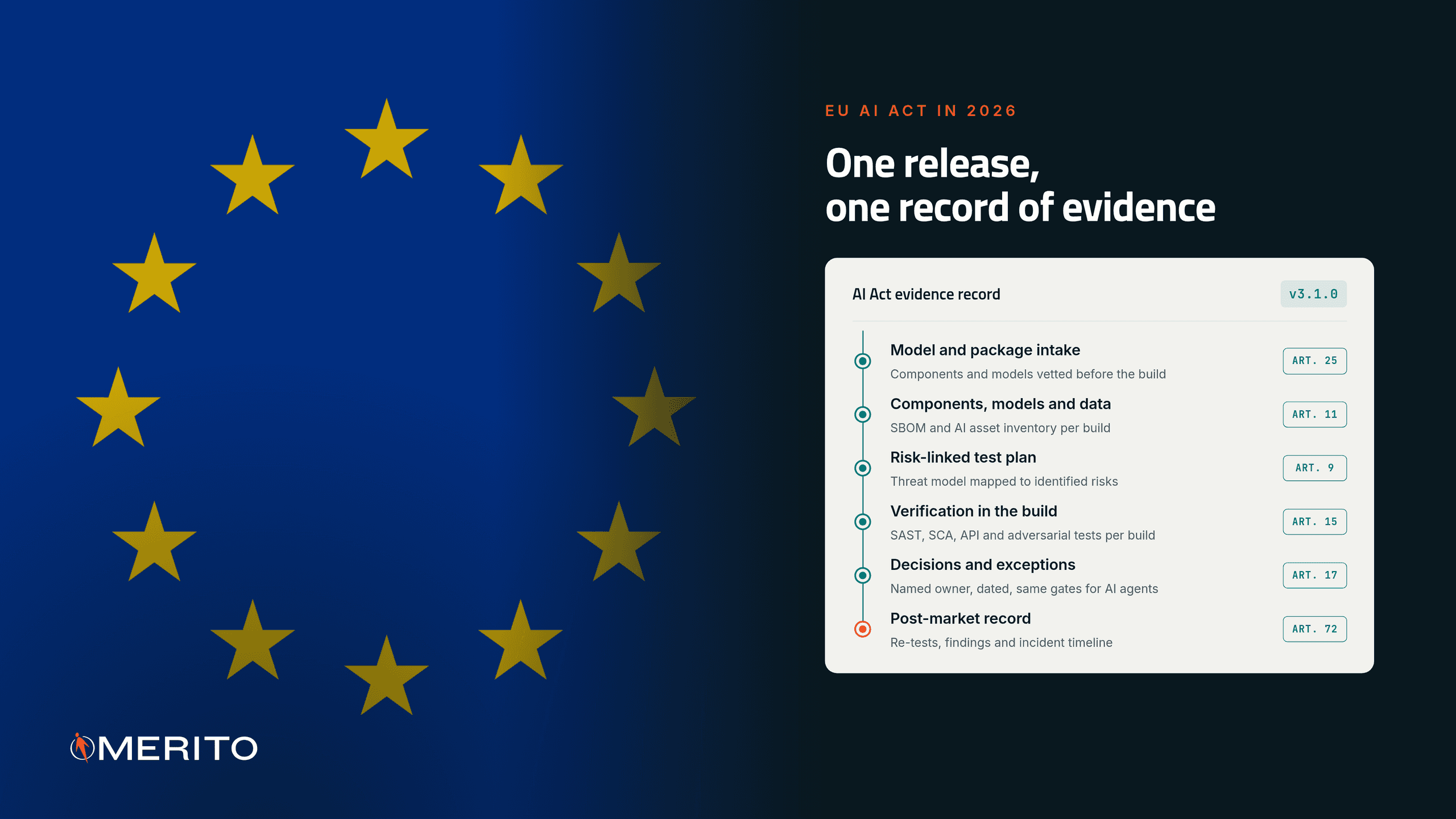
Read one article at a time, the Act resembles a set of separate documentation projects. Read against a single release, its security-relevant articles ask for parts of the same record: what went into the system, how it was verified, what was found, what was decided, and what happened after it shipped. The table below shows where application security contributes and where Merito typically helps. Every row assumes the evidence is tied to a specific build.
AI Act requirement | Evidence the program should hold | How Merito helps |
|---|---|---|
Article 9, risk management | Threat models and test plans linked to identified risks | Threat modeling that feeds AppSec findings into the AI risk register |
Article 11 and Annex IV, technical documentation | SBOM plus model and dataset inventory, cybersecurity measures | Component and AI inventory generated per build in formats reviewers accept |
Article 15, robustness and cybersecurity | Static, composition, API, mobile, and adversarial test results per build | Verification in developer and CI workflows, AI feature testing, rescans that confirm fixes held |
Article 17, quality management | Versioned policies, gates, owned exceptions, test and validation records | Gate and exception design, traceability from requirement to test to release |
Article 25(4), value chain | Supplier terms, component and model vetting records | Intake policy that blocks risky packages and models before they enter the build |
Articles 72 and 73, post-market monitoring and incidents | Consolidated findings, remediation history, incident timelines | One system of record for findings and decisions, with continuous re-testing |
A team can hold a strong tool in every row and still stall in review because of a missing join, such as test results nobody can match to a release. Decisions, exceptions, and approvers belong in the same record as findings, since Articles 17 and 72 care about what happened next. Some requirements sit outside application security, including data governance under Article 10, human oversight under Article 14, and the fundamental rights impact assessment under Article 27. Legal, data, and governance teams own those. AppSec's contribution is security evidence reliable enough for them to cite instead of rebuilding.
Open questions worth watching
The Cyber Resilience Act already overlaps for AI shipped inside products with digital elements, with reporting obligations in force since September 11, 2026. It deems high-risk AI systems that meet its essential cybersecurity requirements to satisfy Article 15 to the extent those requirements cover it. One secure development program can therefore serve both regimes, though two reporting clocks must run inside one incident process. Harmonised standards are also unfinished, and prEN 18282 on AI cybersecurity closed its enquiry vote on July 30, 2026. No draft gives a presumption of conformity until its final text is cited in the Official Journal.
The Act says very little about AI that writes the code for AI systems. For the codebase of a high-risk system, though, Article 17 expects design verification and testing procedures whoever or whatever authored a change. Coding agents in many of the pipelines we assess hold repository write access, call external tools, and install packages. Teams responsible for high-risk systems are starting to ask:
- Which agent or model contributed to this component, and with what repository and pipeline permissions?
- Which tools or MCP servers could it call while it worked?
- Did its output pass through the same gates as a developer's code?
- Would the verification record look any different if a person had written the change?
We know of no provision requiring commit-level AI attribution, and we would not build a program around predicting one. The question with weight under Article 17 is whether verification depends on the author at all. A pipeline that runs the same gates on every change answers it cleanly. Where agents can bypass gates that developers cannot, the gap is a quality management defect today, whatever the AI Act eventually says about it.
How Merito helps
In our engagements, the gap is rarely a missing scanner. More often, the tools an organization already licenses report into different consoles and were never pointed at the AI systems. We start with the organization's role in the value chain, which systems plausibly fall under Annex III or Annex I, and which obligations already apply. We then map existing capabilities to the relevant articles and close gaps in the order that yields usable evidence soonest. That typically means inventorying models and datasets, gating third-party components at intake, testing AI features directly, and holding coding agents to the same gates as developers.
Several products in Merito's portfolio already extend composition analysis into the AI supply chain, which is where Annex IV inventory and Article 25(4) intake evidence usually begin. Checkmarx AI Supply Chain Security identifies AI components embedded in source code and applies policy to how they are used. Black Duck SCA detects models sourced from repositories such as Hugging Face, including ones missing from build manifests, and surfaces their model cards, licenses, and training data details. Sonatype Lifecycle brings AI component visibility into SBOM governance and policy enforcement, and Snyk Open Source sits alongside an AI-BOM command in the Snyk CLI that lists models, datasets, and tools and tests them against policy. Each approaches the inventory problem from a different angle, and the right starting point is usually the tooling a team already runs.
Most engagements begin with Merito's MAPS Assessment, and our Application Security practice stays with the program through implementation, integration, and managed services as standards are cited. December 2027 is enough time to build this record as a byproduct of normal delivery, provided capture starts while releases are still shipping. Organizations that wait will be reconstructing evidence from old builds and scattered consoles, which is slower and much harder to defend. The ones that start now will reach their first high-risk review with an export rather than a project.
Sources
- EUR-Lex, Regulation (EU) 2024/1689 (Artificial Intelligence Act): https://eur-lex.europa.eu/eli/reg/2024/1689/oj/eng
- EUR-Lex, Regulation (EU) 2026/1744 (Digital Omnibus on AI): https://eur-lex.europa.eu/eli/reg/2026/1744/oj/eng
- EUR-Lex, Regulation (EU) 2024/2847 (Cyber Resilience Act): https://eur-lex.europa.eu/eli/reg/2024/2847/oj/eng
- Orrick, "EU AI Act Update: Digital Omnibus Finalizes 8 Compliance Changes" (July 2026): https://www.orrick.com/en/Insights/2026/07/EU-AI-Act-Update-Digital-Omnibus-Finalizes-8-Compliance-Changes
- Cloud Security Alliance, "EU AI Act's High-Risk Deadline: Deferred, Not Cancelled" (2026): https://labs.cloudsecurityalliance.org/research/csa-research-note-eu-ai-act-high-risk-deadline-omnibus-20260/
- Gibson Dunn, "EU AI Act Omnibus Agreement: Postponed High-Risk Deadlines and Other Key Changes" (May 2026): https://www.gibsondunn.com/eu-ai-act-omnibus-agreement-postponed-high-risk-deadlines-and-other-key-changes/
- European Commission, Q&A on the General-Purpose AI Code of Practice: https://digital-strategy.ec.europa.eu/en/faqs/qa-final-version-code-practice-general-purpose-ai
- European Commission, Understanding the standardisation of the AI Act: https://digital-strategy.ec.europa.eu/en/faqs/understanding-standardisation-ai-act
- iTeh Standards, prEN 18282 status: https://standards.iteh.ai/catalog/standards/cen/8cdcbbe8-5409-4a98-af3e-d70b39e9d7d1/pren-18282
- KPMG Law, legal changes in 2026 including CRA reporting obligations: https://kpmg-law.de/en/legal-changes-in-2026-what-companies-should-prepare-for-new-obligations-and-planned-relief-at-a-glance/