Insights

Merito Insights

Fresh thinking on secure software delivery, DevOps best practices, and the people-first approach that powers our clients’ success.

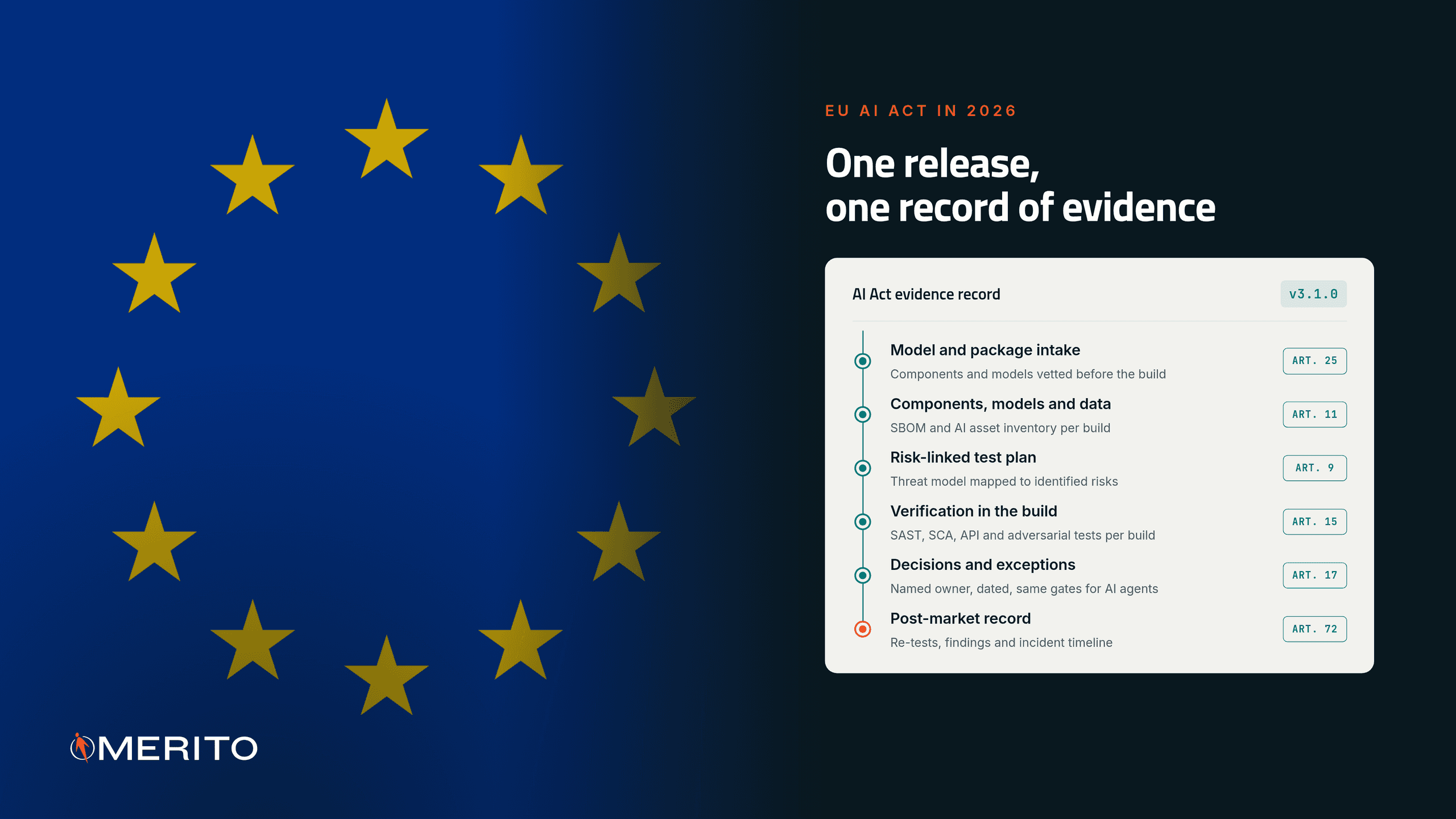
EU flag fading into a dark panel headed “EU AI Act in 2026: One release, one record of evidence,” with a six-step evidence path: model and package intake (Art. 25), components, models and data (Art. 11), risk-linked test plan (Art. 9), verification in the build (Art. 15), decisions and exceptions (Art. 17), and post-market record (Art. 72).
Application Security and DevSecOps

A Holistic Approach to Secure Development Under the EU AI Act

This article explains how organizations can meet the secure development expectations of the EU AI Act after the Digital Omnibus on AI (Regulation (EU) 2026/1744). It maps the Act's security-relevant articles, especially Article 15, to application security evidence for three roles: GPAI model producers, AI system builders, and acquirers or deployers. It separates binding obligations from voluntary guidance and draft standards such as prEN 18282, covers the Cyber Resilience Act overlap, and describes how Merito helps connect existing AppSec capabilities into release-level evidence.

  • Application Security
  • Compliance
  • SBOM
  • DevSecOps
  • SDLC
  • AI
  • Audit
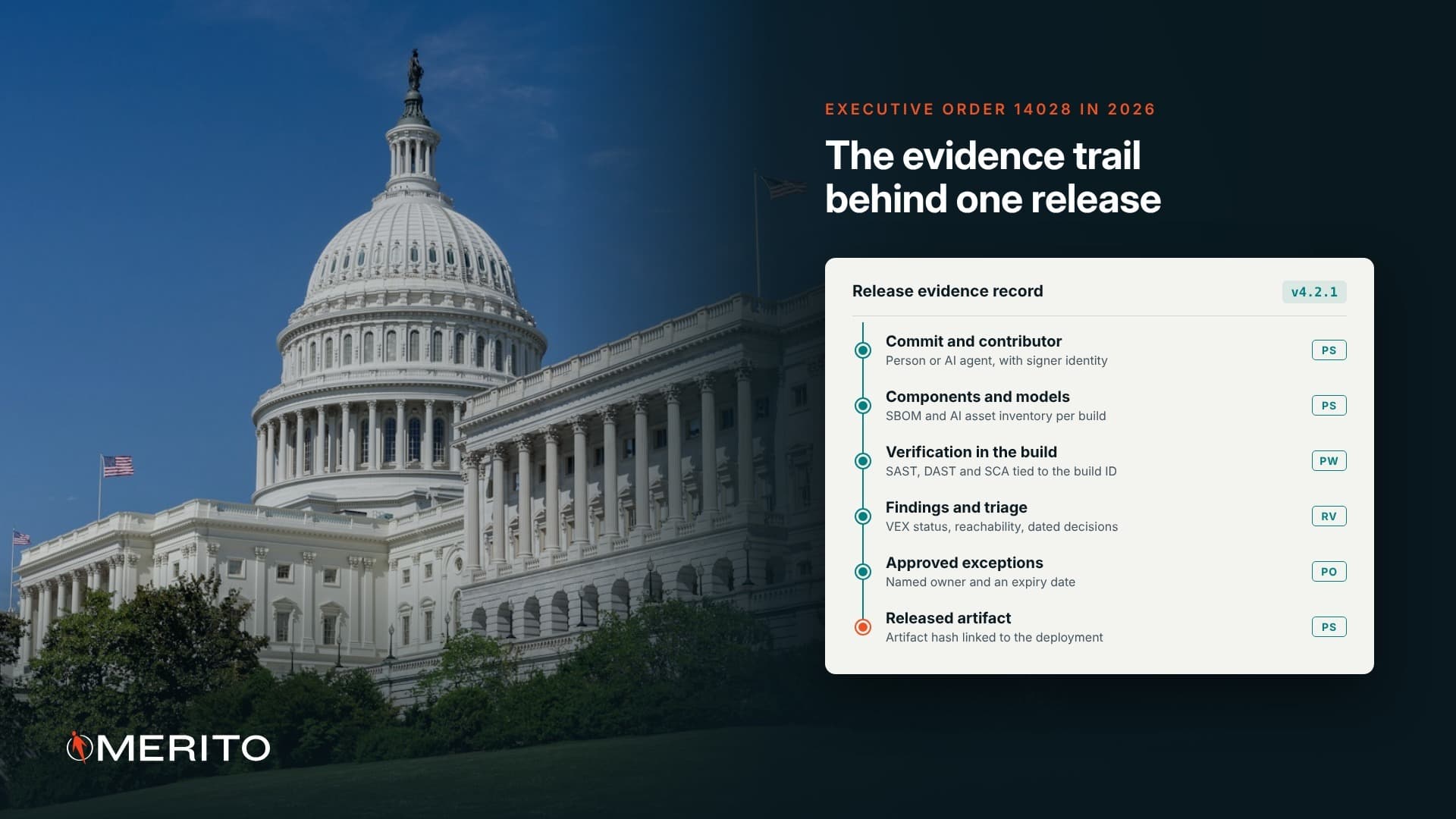
Illustration of a release evidence record for version 4.2.1 beside the US Capitol. It traces six linked steps tagged with their SSDF practice groups: commit and contributor, components and models, verification in the build, findings and triage, approved exceptions, and released artifact. Merito logo bottom left.
Application Security and DevSecOps

Executive Order 14028 in 2026: What Federal Buyers Will Ask Your AppSec Program

Executive Order 14028 remains in effect, but OMB memo M-26-05 (January 2026) replaced the standard secure software attestation with agency-led, risk-based review, and FAR Case 2023-002 was withdrawn in March 2026. Executive Order 14409 (June 2026) adds voluntary AI security mechanisms without new contractor obligations. This article explains what federal buyers are likely to ask software suppliers, how SBOM, VEX, and AI asset inventory fit in, and how the SSDF supports a release-level evidence chain.

  • Application Security
  • Compliance
  • SBOM
  • DevSecOps
  • SDLC
  • AI Coding
  • Audit
  • Executive Order 14028
  • EO 14028
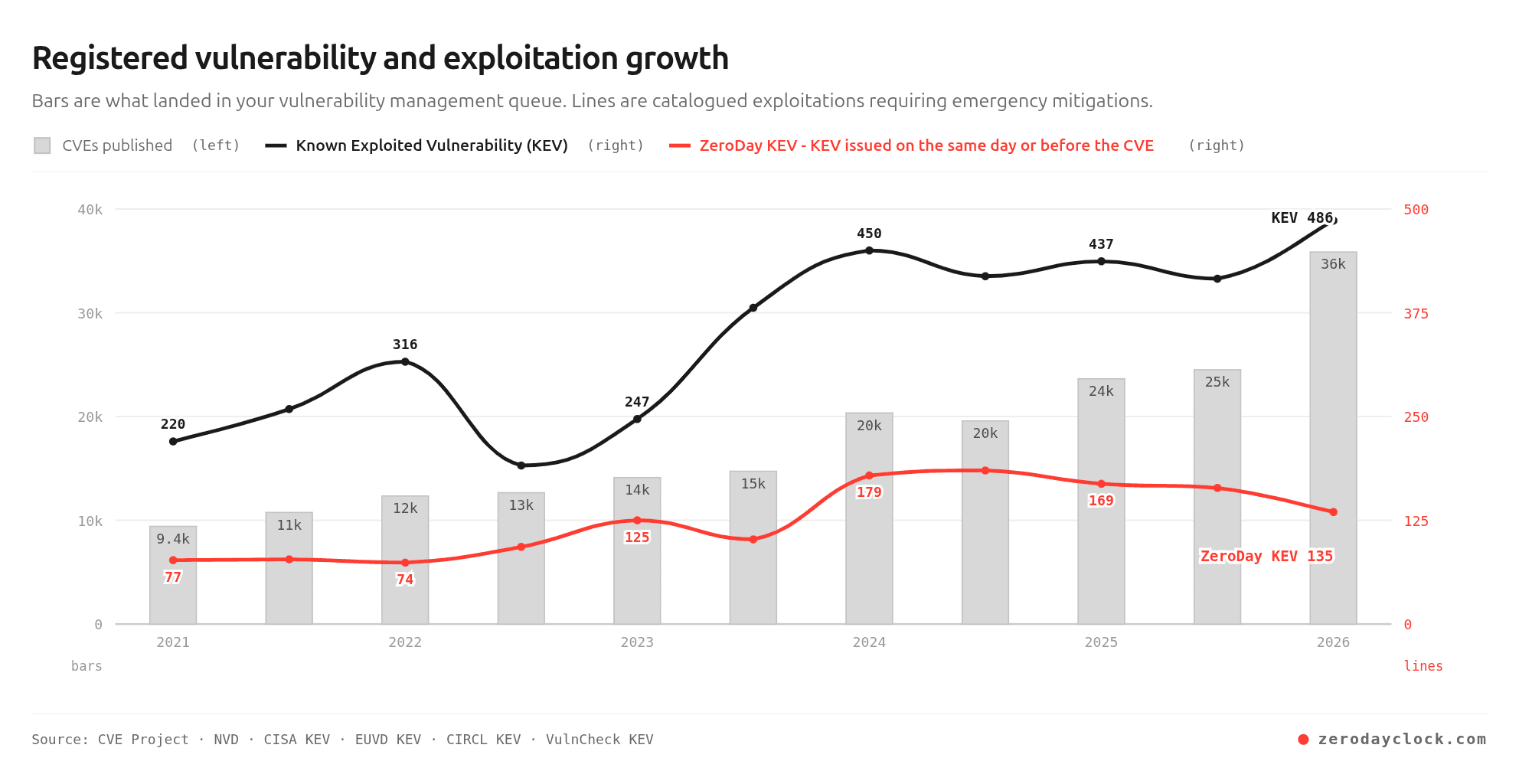
Chart from zerodayclock.com of registered vulnerability and exploitation growth from 2021 to 2026. CVEs published per half year rise from 9.4k to 36k while known exploited vulnerabilities (KEV) rise from 220 to 486.
Application Security and DevSecOps

Checkmarx Fusion: How Hybrid Scanning Raises SAST Accuracy

Checkmarx Fusion is a hybrid vulnerability detection layer in Checkmarx One that combines deterministic, rules-based SAST with a language-agnostic AI engine and curated frontier AI models, reconciled into a single result set. Checkmarx reports an F1 score of 0.741, versus roughly 0.20 for legacy rule-based SAST, and describes the approach as producing consistent results across scans while extending coverage to vulnerabilities with no existing rule or CVE.

  • Checkmarx
  • SAST
  • Application Security
  • DevSecOps
  • AI
Picture showing Engineer Protecting Against AI Cyber Threats with title "The 4 Things Every AppSec Vendor Now Ships, and the 4 We Still Need to Solve" and subtitle "Triage, autofix, IDE integration and grounded output are now table stakes. Re-testing, AI-BOM, mobile and agent guardrails will decide the next 12 months." with Blog Pill and Merito Logo
Application Security and DevSecOps

AppSec for the AI Era: What's Converged, and What's Still Taking Shape

AppSec vendors have converged on exploitability-scored triage, autofix pull requests, coding-agent integration, and grounded output, making those four things table stakes, not differentiators. Real competitive separation over the next 12 months will happen in four unsolved areas: continuous re-testing after a fix ships, AI-BOM, mobile AppSec keeping pace with embedded AI, and agent guardrails that enforce policy at the execution harness, not just the agent's decisions.

  • Application Security
  • AI
  • AI Coding
  • DevSecOps
  • SBOM
  • SCA
  • Compliance
vendor support to resolve a software application ticket
Application Security and DevSecOps

Deepsec Shows Why the Security Checkbox Was Never Enough

Security teams need more than code scanning. Explore how deepsec fits into a modern AppSec strategy with ASPM, DevSecOps governance, and layered validation.

  • deepsec
  • SCA
  • SAST
  • DAST
Computer with code on screen
Application Security and DevSecOps

Application Security in the Age of Agentic Coding: Why Software Bills of Materials (SBOMs) Matter More Than Ever

As agentic coding systems and AI-assisted development reshape software creation, understanding what goes into your codebase is no longer optional—it’s essential. Software Bills of Materials (SBOMs) have become the cornerstone of transparency and trust in modern application security, helping organizations mitigate risks introduced by complex, AI-generated dependencies.

  • AI
  • Application Security
  • SBOM

Frequently Asked Questions

Questions about the Merito blog