Executive Order 14028 was signed in 2021, a few months after the SolarWinds compromise showed how a trusted build pipeline could carry an attacker's code into thousands of customer environments. For most of the years since, federal software suppliers answered it with a signed secure software attestation on the CISA Common Form. On January 23, 2026, OMB memo M-26-05 rescinded M-22-18 and M-23-16, the memos that made that form a standard requirement. Agencies may still request attestations and SBOMs, and each now decides whether to based on its own risk assessment.
For some AppSec leaders, the memo could read as permission to park their SSDF work. We read it as a harder test. Each agency can now ask about the specific release it is buying and the vulnerability decisions attached to it, phrased its own way. When we at Merito mapped the practices behind the order, and the AI guidance layered on top of it, against the programs we help customers run, most of the gaps sat in the handoffs between tools.
Where the requirements stand in September 2026
Executive Order 14028 is still in force, and the Federal Register lists no revocation. The contract rule that would have enforced the attestation, FAR Case 2023-002, was withdrawn on March 6, 2026, and the August 2026 Unified Agenda reported it closed. That followed M-26-05 and, before it, Executive Order 14306 of June 2025, which dropped the plan to write attestation into the Federal Acquisition Regulation. Section 4 of the 2021 order was untouched and still calls for automated vulnerability checks before release, provenance data, an SBOM for each product, and vendor testing that includes static and dynamic analysis, software composition analysis, and penetration testing.
NIST SP 800-218, the Secure Software Development Framework (SSDF), remains the reference most buyers cite, organized into four practice groups: Prepare the Organization (PO), Protect the Software (PS), Produce Well-Secured Software (PW), and Respond to Vulnerabilities (RV). Version 1.1 is still final, since the SSDF 1.2 draft from December 2025 has not been finalized. NIST's SP 800-218A, published in July 2024, is the AI-specific companion to the SSDF, extending secure development practices to AI model producers, AI system builders, and the organizations that acquire those systems. NIST has kept it as final guidance even though the executive order that commissioned it was revoked in January 2025. CISA's 2025 Minimum Elements for an SBOM remains a draft.
Several sources now reach into AI. SP 800-218A pushes teams toward AI Bills of Materials (AI-BOMs), since model provenance is hard to show without an inventory, and the FY2026 NDAA requires a DoD AI security policy (Section 1512) and a framework for acquired AI (Section 1513) that will reach contractors through DFARS and CMMC. The NIST AI Risk Management Framework (AI RMF 1.0), published in January 2023 and now under revision, includes a GOVERN outcome calling for AI system inventories. Executive Order 14409, signed on June 2, 2026, directs agencies to harden federal systems against AI-enabled threats and calls for a voluntary AI cybersecurity clearinghouse to coordinate how vulnerabilities are found, validated, and prioritized. It also sets a voluntary framework for "covered frontier models" and adds no compliance obligations for contractors. None of these names a mandatory AI-BOM or format, and each assumes a supplier can say what AI is inside its product.
Not every source carries the same weight
These documents get quoted side by side in security questionnaires, although they bind very differently. A statute or a signed contract obligates a supplier directly, while draft guidance only signals direction. Most of what follows, including AI-BOMs, VEX, and release-level evidence, sits in the emerging-practice row below. Those practices align with the frameworks without being required by them, and that status should shape what a program funds first.
Source | Status in September 2026 | What it means for a supplier |
|---|---|---|
FY2026 NDAA, Sections 1512 and 1513 | Statute | Binding on DoD; reaches contractors through DFARS and CMMC once the framework exists |
Executive Order 14028 | Executive direction | Directs agencies; reaches suppliers through agency action and contracts |
Executive Order 14409 (June 2026) | Executive direction | Directs agencies; industry participation is voluntary; no new contractor obligations |
OMB M-26-05 | Government-wide policy | Each agency sets its own risk-based requirements |
Agency solicitations and contracts | Contractual | Binding for that contract |
NIST SP 800-218 (SSDF 1.1), SP 800-218A | Final NIST guidance | The reference most buyers point to |
NIST AI RMF 1.0 (AI 100-1), Generative AI Profile (AI 600-1) | Final NIST guidance, voluntary; AI RMF under revision | The common reference for AI governance and risk; broader than secure development |
SSDF 1.2, CISA 2025 SBOM minimum elements | Draft guidance | Direction of travel, not an obligation |
AI-BOM, VEX, release-level evidence | Emerging practice | Expected by more buyers; not universally mandated |
What reviewers are asking for in late 2026
SBOMs are routine in mature programs, and the harder questions concern exposure. During Log4Shell, CISA's Emergency Directive 22-02 gave federal civilian agencies until December 23, 2021 to check internet-facing software against a vendor status list, and suppliers spent those days answering one question per product: are you affected? Vulnerability Exploitability eXchange (VEX) answers that question in machine-readable form, with a status of not affected, affected, fixed, or under investigation, plus a justification when not affected. CISA published minimum requirements for VEX in April 2023, though we know of no government-wide requirement to publish it. Reachability analysis and dated triage decisions are the raw material, and they are worth keeping even for teams that never publish VEX.
SSDF practice PW.4 asks teams to reuse well-secured software, and more programs enforce it at intake by blocking risky packages and AI models before they reach a build. The XZ Utils backdoor (CVE-2024-3094, March 2024) showed why intake needs provenance data as well as vulnerability data, since the malicious code shipped in release tarballs through a trusted maintainer. For AI components, CycloneDX has supported models and datasets since version 1.5 and SPDX 3.0 added AI and Dataset profiles, so models, datasets, metadata, licenses, and provenance are well represented. Agents, MCP servers, agent skills, prompts, tool integrations, and runtime context are not yet represented consistently, and we group them under the broader term AI asset inventory. The inventory problem is expanding faster than the standard formats used to describe it.
An evidence chain for each release
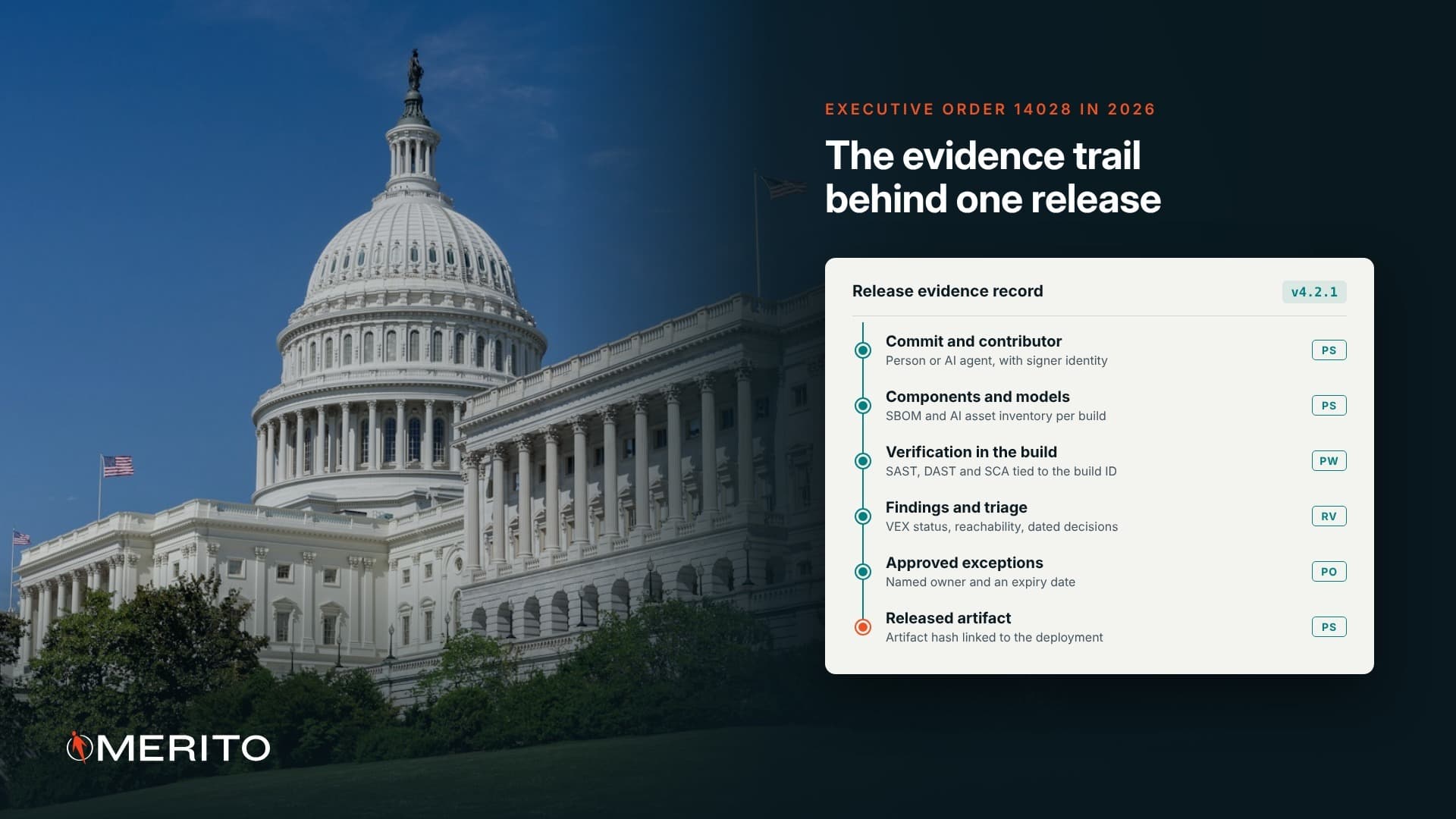
Risk-based reviewers increasingly ask about a specific release, such as version 4.2.1 of a product an agency is about to deploy. Its trail begins with the source commit and the person or AI agent who made it, then runs through the build, the components and models inside it, and the security controls that ran against it. It continues through the findings, how each was triaged, and whether it ended in a fix or an approved exception, and closes with the released artifact and its deployment. Most of that data already exists in some system, and its value depends on whether it can be tied to the same release. A SAST report with no build ID shows only that scanning happened somewhere, while the same report linked to the commit, artifact hash, exception, and deployment record documents what happened to version 4.2.1. Dashboards rarely provide that link on their own, which is why we treat traceability as the core of a program's evidence.
How the SSDF supports that chain
Read through the evidence chain, each SSDF practice group answers a different question about the same release. PO records who set the policy and accepted the risk, and PS records what went into the release and who touched it. PW records which verification ran during the build, and RV records what happened after something was found. A gap in any group shows up as a missing link for the others, as the table below shows.
SSDF group | The question it answers for a release | Evidence in the chain | How Merito helps |
|---|---|---|---|
Prepare the Organization (PO) | Who set the policy, criteria, and acceptable risk? | Versioned policies, gate criteria, owners, exception approvers, training records | Policy and gate design, exception workflows with named owners, secure-coding enablement based on your real flaw patterns |
Protect the Software (PS) | What source, components, models, identities, and artifacts made up this release? | Commit and signer identity, SBOM and AI asset inventory, artifact hashes, provenance | SBOM and AI inventory per build, formats your buyers accept, traceability from scan to commit to artifact |
Produce Well-Secured Software (PW) | What verification happened while it was built? | Component vetting (PW.4), code analysis (PW.7), testing and fuzzing (PW.8), each tied to a build | Verification built into developer and CI workflows, with every result tied to its build |
Respond to Vulnerabilities (RV) | When something was found, what was decided, by whom, and what happened next? | Findings, VEX, reachability, remediation history, accepted risk with expiry dates | Consolidated findings, dated decisions, remediation metrics beyond MTTR |
What's still taking shape
SSDF 1.2 is a draft, NIST is revising the AI RMF, the DoD framework under Section 1513 has not been published, and M-26-05 lets each agency phrase its own questions. CycloneDX and SPDX describe AI components differently, and two tools in one pipeline can emit different versions. An inventory generated from source also shows only what a repository declares. A model loaded by name at run time, or an MCP server configured on a developer laptop, may never appear in it.
SP 800-218A mainly addresses teams that develop AI models and systems. The faster-growing problem in most enterprises is that AI systems and coding agents now write ordinary application code, and current standards say little about how to account for it. No standard we know of requires commit-level AI attribution, although some tools already record which model contributed to a commit. Teams we work with are starting to ask:
- Which agent or model influenced this code, and with what repository permissions?
- Which tools or MCP servers could it call, and what outside context shaped the output?
- What security verification happened afterward?
- Can the code be checked with the same repeatable controls whether a person or an agent wrote it?
The last question is the practical test. Coding agents can hold repository write access, reach the build system, install packages, read secrets, use CI/CD credentials, call MCP servers, and run commands. NIST's June 2021 definition of "critical software" keyed on attributes like elevated privilege, privileged network access, and functions critical to trust, and it flagged development tools for a possible later phase. That definition is not a universal scope test, NIST no longer updates its explanatory page, and no agency has designated AI agents as EO-critical software, but a privileged coding agent matches several of those attributes in our reading. Knowing which AI is present is no longer enough, and organizations increasingly need to record what it was authorized to do, what influenced it, what it changed, and how those changes were independently verified, which fits the PS practices already applied to human contributors.
How Merito helps
In our engagements, the gap is rarely a missing tool. More often, existing tools do not share identifiers, so scans cannot be tied to builds and triage decisions live in spreadsheets nobody can export. We assess capabilities against the SSDF and SP 800-218A, sort out which frameworks and contracts actually apply, then trace one exposed product through the evidence chain and close the breaks in the order that produces usable evidence fastest. That typically means tying scans to builds and builds to artifacts, turning on inventory features customers already license, bringing coding agents under the same controls as the rest of the pipeline, and routing findings, exceptions, and decisions into one system of record.
Most engagements begin with Merito's MAPS Assessment, and our implementation, integration, and managed services teams stay with the program as requirements shift. Five years after Executive Order 14028, several of its implementing rules are still in flux, and the attestation form most suppliers knew has been retired. The expectation behind it has become more specific. Agencies, prime contractors, and commercial buyers increasingly want to see what was found in a given release and why the version that reached production can be trusted, and a program built around release-level evidence can show them.
Sources
- CISA, Emergency Directive 22-02, Mitigate Apache Log4j Vulnerability (December 2021): https://www.cisa.gov/emergency-directive-22-02
- CISA, Apache Log4j Vulnerability Guidance: https://cisa.gov/uscert/apache-log4j-vulnerability-guidance
- Help Net Security, backdoor found in XZ Utils (CVE-2024-3094), with CISA guidance (March 2024): https://www.helpnetsecurity.com/2024/03/29/cve-2024-3094-linux-backdoor/
- Federal Register, Executive Order 14028 full text and order notes: https://www.federalregister.gov/d/2021-10460
- Federal Register, Executive Order 14409, Promoting Advanced Artificial Intelligence Innovation and Security (June 5, 2026, 91 FR 34565): https://www.federalregister.gov/public-inspection/2026-11415/advanced-artificial-intelligence-innovation-and-security-promotion-efforts-eo-14409
- DirectEmployers, "The White House Just Signaled Where AI Policy Is Heading" (June 2026): https://directemployers.org/2026/06/15/the-white-house-just-signaled-where-ai-policy-is-heading-what-federal-contractors-need-to-know/
- NIST, Executive Order 14028 program page (last updated July 2022): https://www.nist.gov/itl/executive-order-14028-improving-nations-cybersecurity
- NIST, Critical Software Definition (June 2021, page updated May 2026): https://www.nist.gov/itl/executive-order-14028-improving-nations-cybersecurity/software-supply-chain-security-guidance-1
- NIST, Critical Software Definition and Explanatory Material (marked by NIST as no longer updated): https://www.nist.gov/itl/executive-order-improving-nations-cybersecurity/critical-software-definition-explanatory
- NIST, AI Risk Management Framework (AI RMF 1.0 and revision status): https://www.nist.gov/itl/ai-risk-management-framework
- NIST AI Resource Center (AI RMF Playbook and Generative AI Profile): https://airc.nist.gov/
- NIST CSRC, SSDF publications (status of SP 800-218, 800-218A, and 800-218 Rev. 1): https://csrc.nist.gov/Projects/ssdf/publications
- NIST, SP 800-218A announcement (July 2024): https://csrc.nist.gov/news/2024/nist-publishes-sp-800218a
- NIST, SSDF 1.2 initial public draft (December 2025): https://csrc.nist.gov/News/2025/draft-ssdf-version-1-2
- Federal Register, FAR Unified Agenda listing FAR Case 2023-002 as withdrawn March 6, 2026 (published August 14, 2026): https://www.govinfo.gov/content/pkg/FR-2026-08-14/pdf/2026-16612.pdf
- Crowell & Moring, OMB M-26-05 analysis (January 2026): https://www.crowell.com/en/insights/client-alerts/software-de-simplified-trump-administration-rescinds-standardized-secure-software-development-attestation-requirements
- Covington, Inside Government Contracts, OMB rescinds the Common Form (February 2026): https://www.insidegovernmentcontracts.com/2026/02/omb-rescinds-the-common-form-secure-software-attestation-requirement/
- CISA, 2025 Minimum Elements for an SBOM, public comment draft (August 2025): https://www.cisa.gov/resources-tools/resources/2025-minimum-elements-software-bill-materials-sbom
- CISA, Minimum Requirements for VEX (April 2023): https://cisa.gov/sites/default/files/2023-04/minimum-requirements-for-vex-508c.pdf
- CISA, VEX Status Justifications (June 2022): https://www.cisa.gov/sites/default/files/2023-01/VEX_Status_Justification_Jun22.pdf
- CycloneDX, AI/ML-BOM capabilities: https://cyclonedx.org/capabilities/mlbom/
- CycloneDX specification (ECMA-424): https://github.com/CycloneDX/specification/
- SPDX 3 model, AI profile: https://github.com/spdx/spdx-3-model/blob/main/model/AI/AI.md
- Congressional Research Service, Cyber and AI provisions in the FY2026 NDAA (July 2026): https://www.congress.gov/crs-product/IF13197
- Crowell & Moring, FY2026 NDAA AI security framework (July 2026): https://www.crowell.com/en/insights/client-alerts/cmmc-for-ai-defense-policy-law-imposes-ai-security-framework-and-requirements-on-contractors